
Reading Time: 7–9 minutes
Last Updated: August 2026

Quick Answer
Can exercise undo a full day of sitting? Exercise can reduce many of the health risks associated with prolonged sitting, but it cannot literally erase the effects of spending most of the day sedentary. Regular exercise matters, while movement throughout the day adds another important layer.
Introduction
You spend most of the day sitting.
You work at a desk.
You sit during the commute.
You sit again when you get home.
Then, in the evening, you exercise.
For many people, that workout becomes a kind of reassurance. “I exercised today, so the sitting probably doesn’t matter that much.” There is some truth behind that thinking. Exercise matters enormously. But it is not quite that simple.
Core Evidence
WHO recommends that adults limit sedentary time and replace sedentary time with physical activity of any intensity. Adults should also accumulate 150–300 minutes of moderate-intensity aerobic activity or 75–150 minutes of vigorous activity per week. A harmonized meta-analysis of more than 44,000 adults found that higher levels of moderate-to-vigorous physical activity substantially attenuated the association between sedentary time and mortality.
Exercise can substantially offset some risks associated with prolonged sitting, but exercise should not be presented as literally erasing a full day of sitting.
Can exercise undo a full day of sitting?
The evidence suggests that regular physical activity can substantially reduce some of the health risks associated with high sedentary time. But that does not mean several hours in a chair are somehow cancelled by one workout.
The distinction matters because exercise and sedentary behavior are not simply opposite ends of the same scale. You can exercise regularly and still sit too much. And understanding that difference changes how you think about movement during the rest of your day.
Can Exercise Undo a Full Day of Sitting?
If “undo” means completely erase the effects of prolonged sitting, the answer is no. If it means reducing some of the health risks associated with spending a large part of the day sedentary, the answer is more encouraging.
A large harmonized meta-analysis involving more than 44,000 adults examined physical activity and sedentary time together. It found that higher levels of moderate-to-vigorous physical activity were associated with a much weaker relationship between sedentary time and mortality.
This is an important finding. But it is easy to turn it into the wrong message.
It does not mean:
Sit for ten hours and exercise for forty minutes, and everything has been cancelled. It means that physical activity can substantially reduce the risks associated with high sedentary time. Those are not the same thing. Your workout still matters. So does what happens between workouts.
Why Exercise Still Matters If You Sit All Day
A sedentary workday does not make exercise pointless. Far from it. Exercise challenges the cardiovascular system.
It asks for muscles to produce force.
It raises energy expenditure.
It improves physical capacity.
And regular physical activity is associated with benefits across cardiovascular, metabolic, mental, cognitive, and overall health outcomes. This is why someone who sits for much of the day should not conclude that exercising is useless. The opposite is true. If your daily routine involves long periods of sitting, exercise becomes an important part of your overall movement pattern.
The mistake comes when the workout is treated as a complete replacement for movement during the rest of the day.
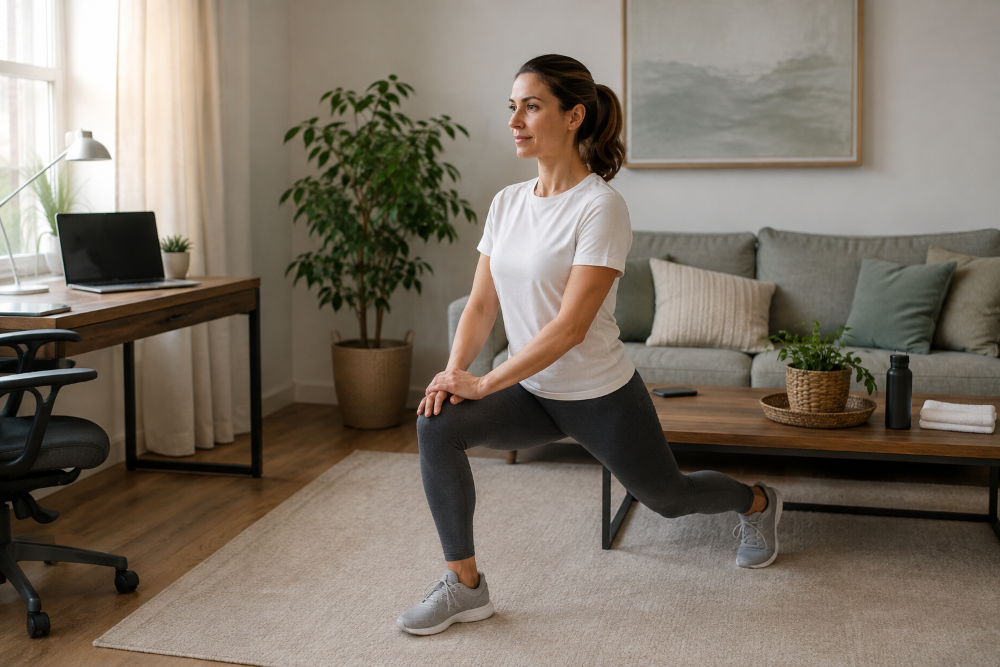
What Exercise Can and Cannot Offset
Exercise can improve your body’s capacity.
It can strengthen muscles.
It can improve cardiorespiratory fitness.
It can contribute to better metabolic health.
It can also reduce some of the health risks associated with insufficient physical activity and high sedentary time.
But exercise cannot change the fact that you spent the previous six, eight, or ten hours sitting. That time still happened. Your body experienced those hours differently from a day containing regular movement. And posture changes from prolonged sitting. This is why “exercise versus sitting” is the wrong comparison.
The better question is
What does the entire day look like?
Can Exercise Undo a Full Day of Sitting If You Move During the Day?
This is where the answer becomes more useful.
Imagine two people.
Both sit at a desk for most of their working day.
Both exercise for 45 minutes after work.
But one person remains seated almost continuously throughout the workday.
The other stands periodically, walks to another room, takes the stairs, walks during part of lunch, and breaks up long periods of sitting.
Both exercises.
But their days contain different amounts and patterns of movement.
That distinction matters.
WHO defines sedentary behavior as waking time spent sitting or lying with low energy expenditure and recommends that adults limit sedentary time while replacing it with physical activity of any intensity where possible.
So the goal is not simply to add exercise to a sedentary day. It is to gradually make the entire day less sedentary where circumstances allow.

Why Breaking Up Sitting Matters
A workout at the end of the day and a short movement break during the workday are not necessarily doing the same thing. One provides a structured physical stimulus. The other interrupts prolonged sedentary behavior. Research supports the idea that breaking up sedentary periods with physical activity can have immediate benefits.
A 2024 systematic review and meta-analysis of 25 randomized controlled trials found that interrupting continuous sedentary time with physical activity acutely improved cognitive function. The evidence for longer-term cognitive effects remained inconclusive.
That distinction is important.
The evidence does not justify promising that every short movement break will produce long-term health improvements. But it does show that sitting continuously is not the only pattern worth considering. Sometimes the interruption itself matters.
One Workout vs. Movement Throughout the Day
| Pattern | What It Provides | What It Does Not Replace |
| One workout after work | Structured physical activity and fitness stimulus | Movement during long sitting periods |
| Frequent light movement | Regular interruptions to sedentary time | Structured exercise for fitness |
| Workout plus movement breaks | Both structured exercise and daily movement | — |
| Prolonged sitting with little exercise | Limited physical stimulus | Both regular exercise and movement |
The strongest approach is therefore not choosing one over the other. It is combining them. Exercise builds capacity. Movement throughout the day changes the pattern of inactivity.

How Much Exercise Helps Offset Sitting?
There is no precise amount of exercise that can be described as a universal “sitting cancellation” dose.
One widely discussed analysis of more than 44,000 adults found that around 30 to 40 minutes per day of moderate-to-vigorous physical activity was associated with substantially attenuating the relationship between high sedentary time and mortality. But that figure should not be turned into a personal formula.
It does not mean that exactly 30 or 40 minutes of exercise makes ten hours of sitting harmless.
WHO’s recommendations remain the more appropriate general benchmark: adults should accumulate at least 150 to 300 minutes of moderate-intensity aerobic physical activity per week, or 75 to 150 minutes of vigorous activity, or an equivalent combination. Adults should also perform muscle-strengthening activities involving all major muscle groups on at least two days each week.
WHO also specifically recommends limiting sedentary time. That second part is easy to overlook.
What If Your Work Requires Long Hours of Sitting?
For some people, reducing sitting is not simply a matter of deciding to “move more.” A computer-based job requires sitting. Driving requires sitting. Some forms of work provide very little freedom to change position. You have to check the early signs of too much sitting.
That means the realistic question is not
“How can I stop sitting?”
It is:
“Where can I interrupt the sitting I cannot avoid?”
Perhaps you stand during part of a phone call.
Perhaps you walk to speak with a colleague instead of sending a message.
Perhaps you take a short walk during lunch.
Perhaps you stand and move between tasks.
None of these replaces exercise.
And none needs to.
They simply change what happens during the hours between workouts.
Exercise Is Not Compensation
There is a subtle problem with thinking about exercise as compensation.
You sit all day.
You feel that you have been inactive.
You exercise.
Then you feel that the debt has been paid. But your body is not keeping a simple ledger. Exercise is valuable because it provides a physical stimulus. Movement throughout the day is valuable because it prevents the entire day from becoming dominated by prolonged inactivity. One does not make the other unnecessary.
This is why a person can be both:
physically active
and
highly sedentary.
Those descriptions can be true at the same time.
A More Useful Way to Think About Sitting and Exercise
Instead of thinking:
“I exercised, so I have dealt with the sitting.”
Think:
“My workout is one part of my movement for the day.”
“Why sitting all day can leave you feeling tired.”
That small change in thinking matters. It removes the idea that exercise has to compensate for everything that happened before it.
Your workout can be a workout.
Your walk can be a walk.
Standing between tasks can simply be standing.
You do not need every movement to serve as a correction for something else.
You need movement to become a normal part of the day.
A Pause for Reflection
Think about yesterday.
How long did you sit before your first real movement break?
How many hours passed between getting to work and leaving your chair?
Did your workout happen because you wanted to exercise, or partly because you felt you needed to compensate for the day?
And after the workout, did the rest of the evening become sedentary again?
There is no perfect answer. The point is simply to see the whole pattern. Because once you look beyond the workout, you may notice something that was easy to miss before.
Your exercise session may be healthy.
Your day may still contain too much sitting.
Both can be true.
The Myth of “Making Up” for Sitting
| Myth | What the Evidence Suggests |
| A hard workout completely cancels sitting all day. | Exercise can reduce some risks associated with sedentary time, but it does not literally erase prolonged sitting. |
| If you exercise, movement breaks are unnecessary. | Exercise and reducing sedentary time address different aspects of daily movement. |
| Light movement is meaningless compared with exercise. | WHO recommends replacing sedentary time with physical activity of any intensity where possible. |
| There is one exact amount of exercise that cancels sitting. | Evidence does not support a universal “cancellation” number. |
Key Takeaways
- Can exercise undo a full day of sitting? Not completely.
- Regular exercise can substantially reduce some of the health risks associated with high sedentary time.
- Exercise and sedentary behavior are separate parts of your daily movement pattern.
- Breaking up prolonged sitting can provide benefits beyond a single workout.
- WHO recommends both regular physical activity and limiting sedentary time.
- The goal is not to compensate for sitting with exercise but to create a day that contains more movement overall.
Frequently Asked Questions
Can exercise undo a full day of sitting?
Exercise can reduce many risks associated with prolonged sitting, but it cannot literally erase the effects of spending most of the day sedentary.
Is 30 minutes of exercise enough to offset sitting all day?
There is no universal cancellation dose, although research suggests substantial physical activity can attenuate some risks associated with high sedentary time.
Is walking during the workday as important as exercising?
Walking and other movement breaks do not replace structured exercise, but they can reduce uninterrupted sedentary time and contribute to overall physical activity.
Can you exercise regularly and still sit too much?
Yes. A person can meet physical-activity recommendations while also spending a large proportion of the day sitting.
How much exercise should adults get each week?
WHO recommends 150–300 minutes of moderate aerobic activity or 75–150 minutes of vigorous activity each week, plus muscle-strengthening activity on at least two days.
Conclusion: Exercise Helps, But It Does Not Erase Sitting
So, can exercise undo a full day of sitting?
Not completely. But that does not make your workout less valuable. Regular exercise can substantially reduce the health risks associated with high sedentary time, while reducing sedentary time itself adds another layer of protection.
The more useful approach is not to think of exercise as repayment. It is to think of movement as something that happens throughout the day.
Your workout builds physical capacity.
Your walk interrupts sitting.
Your ordinary daily movement keeps your body from spending every non-exercise hour in the same position.
None of these needs to be cancelled.
Together, they create a more active day. And perhaps that is the better question to ask.
Not:
“Did my workout undo all that sitting?”
But:
“How much movement did my whole day contain?”
Medical Disclaimer
This article is intended for educational and informational purposes only. It is not a substitute for professional medical advice, diagnosis, or treatment. Individual health needs vary, and research findings do not determine what is appropriate for every person.
When to Consult a Healthcare Professional
If you experience persistent or worsening pain, unexplained weakness, numbness, significant swelling, chest pain, shortness of breath, dizziness, or other concerning symptoms, consult a qualified healthcare professional rather than assuming they are caused by sitting or lack of exercise.
References
- WHO Guidelines on Physical Activity and Sedentary Behavior
- WHO — Physical Activity Fact Sheet
- British Journal of Sports Medicine
- WHO—Every Move Counts
Early Signs Your Body Is Struggling With Too Much Sitting
Why Trust This Article?
This article is based primarily on World Health Organization physical-activity and sedentary-behavior guidelines, systematic reviews, meta-analyses, and peer-reviewed research. It distinguishes between evidence about physical activity and evidence about sedentary behavior rather than treating exercise as a simple cure for prolonged sitting.
What the evidence tells us
- WHO recommends 150 to 300 minutes of moderate-intensity aerobic activity per week, or 75 to 150 minutes of vigorous activity, for adults.
- WHO recommends limiting sedentary time and replacing it with physical activity of any intensity where possible.
- A harmonized meta-analysis included more than 44,000 adults and found that higher physical activity substantially attenuated the association between sedentary time and mortality.
- A 2024 systematic review and meta-analysis included 25 randomized controlled trials involving 1,289 participants and found that acute interruption of sedentary time with physical activity improved cognitive function, although evidence for chronic effects remained inconclusive.

I’m Mr. Baig, founder of Recover Better Lab. I create evidence-based fitness recovery content to help beginners recover smarter and build sustainable healthy habits.
Mission: My mission is to provide trustworthy, research-backed recovery and fitness content that helps people optimize their health, performance, and overall well-being.