
Reading Time: 7 Minutes
Last Reviewed: August 2026

You spend the day sitting at your desk, answering emails, attending meetings, and working through your tasks. By the time you finish, you feel completely exhausted. Your shoulders are tense, your back feels stiff, and even simple activities after work seem difficult. If you’ve ever asked yourself, “Why do I feel tired after sitting all day?” you’re not imagining it. Many people assume that because they haven’t done physically demanding work, they shouldn’t feel so drained. Yet prolonged sitting combined with continuous mental effort can leave both your body and mind feeling depleted.
Although sitting requires far less energy than physical labor, it doesn’t mean your body is truly at rest. Throughout the day, your muscles continue supporting your posture, your brain remains focused on solving problems and making decisions, and your body experiences long periods with very little movement. Together, these factors can contribute to the fatigue many office workers, remote employees, students, and other desk-based professionals experience every day.
Understanding why this happens is the first step toward recognizing how prolonged sitting affects your overall well-being.
Why Do I Feel Tired After Sitting All Day?
Feeling tired after sitting all day isn’t caused by a single factor. Instead, it’s usually the result of several physical and mental demands building up throughout the day.
While you may not be lifting heavy objects or walking long distances, your body is continuously adapting to a prolonged seated position. The muscles that support your neck, shoulders, back, and core remain active to help maintain posture. At the same time, your brain is processing information, solving problems, responding to messages, and making decisions, often without many opportunities to rest.
Hours of limited movement can also reduce the natural changes in posture and muscle activity that occur during a more active day. Instead of alternating between different movements, your body remains in a relatively fixed position, which may contribute to stiffness, discomfort, and a growing sense of fatigue.
Rather than thinking of sitting as complete rest, it’s more accurate to think of it as a different type of workload. Your body may be relatively inactive, but it is still working to maintain posture, support concentration, and adapt to prolonged periods of minimal movement. Over time, these demands can leave you feeling surprisingly exhausted, even though your day involved little physical activity.
Sitting Doesn’t Mean Your Body Stops Working
When you sit for long periods, your body doesn’t switch into a completely relaxed state. Several muscle groups continue working quietly in the background to keep you balanced and upright.
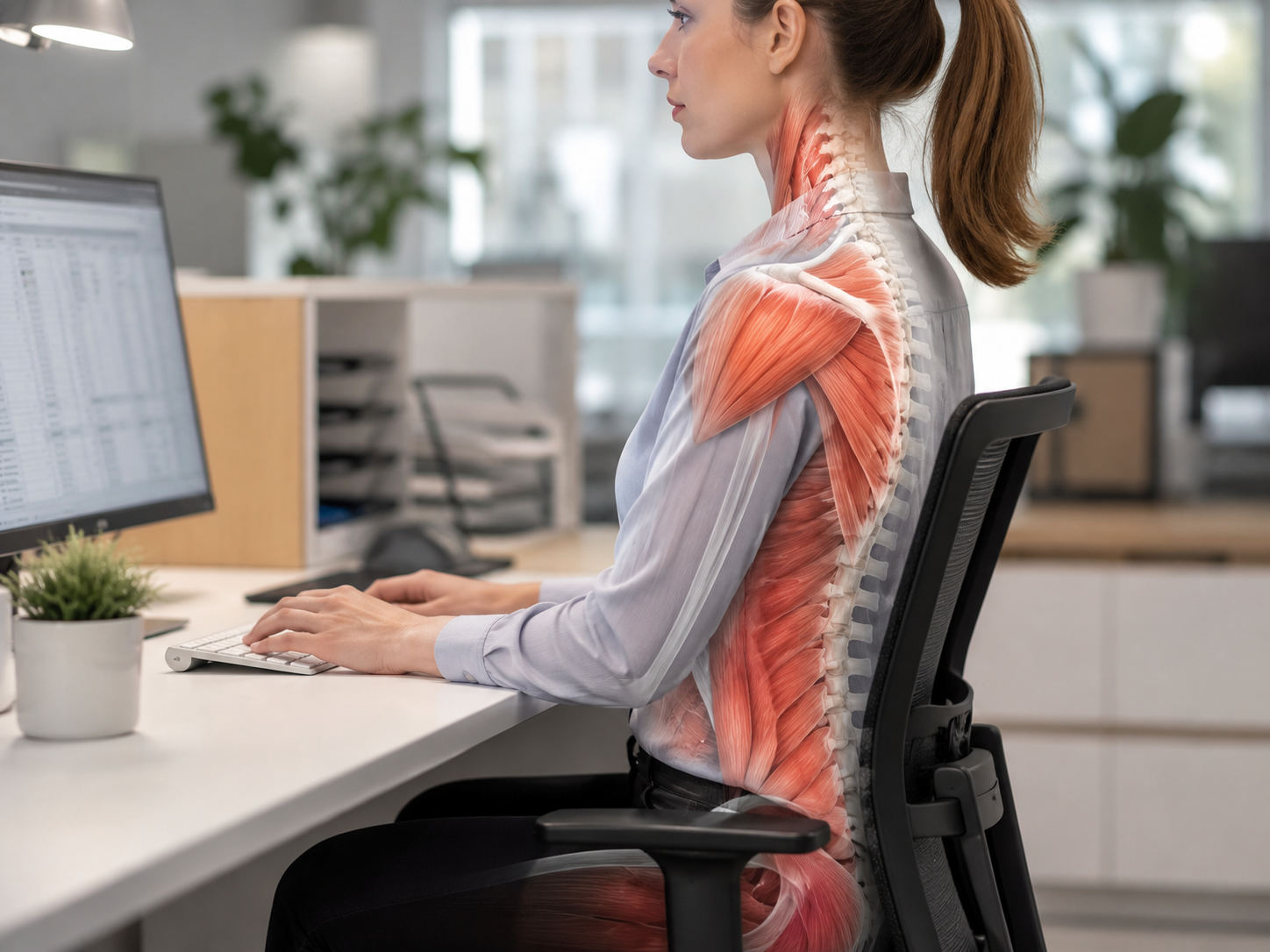
The muscles around your neck stabilize your head as you look at a computer screen. Your shoulders support your arms while you type or use a mouse. Your back and core muscles help maintain your seated posture. Although these muscles aren’t working as intensely as they would during exercise, they often remain engaged for hours with very few opportunities to fully relax.
This continuous, low-level muscle activity can gradually contribute to tension and discomfort, particularly if your posture rarely changes throughout the day. Many people don’t notice these small physical demands while they’re working, but they often become more noticeable later in the afternoon or after the workday ends.
Your Brain Uses Energy Throughout the Day
Physical movement isn’t the only thing that consumes energy. Your brain is one of the most energy-demanding organs in the body, and desk-based work often requires prolonged periods of concentration.
Reading reports, analyzing information, attending virtual meetings, solving problems, and making decisions all require sustained mental effort. As these cognitive demands accumulate, they can contribute to mental fatigue, which many people experience as difficulty concentrating, reduced motivation, slower thinking, or an overall feeling of exhaustion.
Because mental and physical fatigue often occur together, it’s common to finish a day of desk work feeling both mentally drained and physically tired, even though your body has spent most of the day sitting.
Your Muscles Are Working Even When You Feel Still
One of the biggest misconceptions about sitting is that the body is completely resting. In reality, remaining in the same position for hours places a different type of demand on your muscles.
Unlike walking or exercising, where muscles repeatedly contract and relax, prolonged sitting keeps certain muscles engaged for extended periods with very little variation. This continuous, low-level effort may not feel physically demanding in the moment, but over time it can contribute to muscle fatigue and discomfort.
Static Muscle Tension Builds Gradually
When you work at a desk, the muscles in your neck, shoulders, upper back, lower back, and core help support your posture throughout the day. If you rarely change position, these muscles continue working without many opportunities to recover. This doesn’t usually cause immediate pain. Instead, it often develops gradually.
You may first notice:
- Tight shoulders by the afternoon.
- A stiff neck after looking at a screen for several hours.
- Lower back discomfort when standing up.
- Hips feeling tight after leaving your chair.
- A general sense of physical heaviness.
These symptoms are often subtle at first, which is why many people dismiss them as a normal part of office work.
Remaining in One Position Requires Constant Adjustment
Even though sitting appears motionless, your body is constantly making small adjustments to keep you balanced. Tiny postural corrections occur throughout the day as your muscles stabilize your spine, support your head, and maintain your seated position. While each adjustment requires only a small amount of effort, repeating this process over many hours can contribute to physical fatigue.
This is one reason why many people feel surprisingly tired after a full day at a desk. The workload isn’t created by intense movement but by the prolonged effort of maintaining the same posture for too long.
Why Desk Work Can Feel More Exhausting Than Physical Work
Many people are surprised to find that they sometimes feel more exhausted after a day at the office than after spending several hours doing household chores, gardening, or walking. The difference isn’t simply the amount of physical activity. It’s the type of demands placed on your body and brain.
Desk work often combines prolonged sitting with continuous concentration, deadlines, problem-solving, and frequent decision-making. While your muscles remain relatively still, your brain rarely gets a meaningful break.
Decision Fatigue Adds Up
Every workday involves countless decisions. Some are small, such as responding to emails or prioritizing tasks. Others require careful analysis, planning, or problem-solving. Although each decision may seem minor, together they create a significant mental workload.
As this mental effort accumulates, many people experience:
- Reduced concentration.
- Slower thinking.
- Lower motivation.
- A greater sense of overall exhaustion.
By the end of the day, your brain may feel as though it has been working continuously for hours—because it has.
Concentration Is a Form of Work
Maintaining focus for long periods requires sustained attention. Whether you’re reviewing spreadsheets, writing reports, coding, designing, or attending meetings, your brain is continuously processing information. Unlike physical activity, this type of work doesn’t always produce obvious signs of effort. However, prolonged concentration can leave you feeling mentally drained, and that mental fatigue often influences how your entire body feels.

This is why many people describe themselves as “physically exhausted” after a desk job, even though the exhaustion began with sustained mental effort combined with prolonged sitting.
Small Changes Throughout the Day Can Leave You Feeling Drained
Fatigue from prolonged sitting rarely develops because of one long meeting or one afternoon at your desk. More often, it builds gradually through small changes that occur throughout the day.
Hours pass with very little movement. Your posture changes only slightly. Your eyes remain focused on a screen, and your attention shifts from one task to another. Individually, these changes may seem insignificant. Together, they can influence how energetic you feel by the end of the day.
Reduced Movement Affects How Your Body Feels
The human body is designed to move regularly, not to remain in one position for most of the day. Simple movements such as standing, walking to another room, climbing stairs, or changing posture help different muscle groups share the workload. They also encourage normal blood flow and reduce the amount of time muscles stay under continuous tension. When these natural movement patterns become less frequent, many people begin to notice:
- A feeling of heaviness in the legs.
- General body stiffness.
- Reduced energy.
- Less motivation to be physically active after work.
These experiences don’t necessarily mean something is wrong, but they may indicate that your body has spent too much time in a static position.
Your Body Receives Fewer Opportunities to Recover
Recovery isn’t something that happens only after exercise. Throughout the day, your body benefits from brief periods of movement that allow muscles to relax, joints to move through different positions, and posture to reset naturally.
During prolonged sitting, those recovery opportunities become less frequent. Instead of alternating between different movements, the same muscles continue supporting the same posture for extended periods.
As the hours pass, this can contribute to a growing sense of fatigue, even though your work hasn’t involved strenuous physical activity.
Fatigue Is Often the Result of Accumulation
Many people expect fatigue to appear suddenly, but that’s rarely how it develops during desk work. It often starts with small changes that are easy to overlook:
- Sitting through multiple meetings without standing.
- Working through lunch.
- Remaining focused on a screen for several hours.
- Ignoring minor stiffness because you’re busy.
- Delaying movement until the end of the workday.
By evening, these small demands have accumulated. Instead of feeling refreshed after a day that involved little physical activity, you may feel both mentally and physically drained.
Understanding this gradual pattern helps explain why fatigue after prolonged sitting often feels unexpected. It isn’t caused by a single activity but by many hours of limited movement, sustained concentration, and continuous postural demands working together.
Common Signs That Prolonged Sitting Is Affecting You
The effects of prolonged sitting don’t always begin with severe pain or overwhelming fatigue. In many cases, they appear as subtle changes that gradually become part of your daily routine. Because these changes develop slowly, they’re often dismissed as a normal consequence of work, getting older, or simply having a busy schedule. Recognizing these early signs can help you understand whether prolonged sitting may be contributing to how you feel.
You might notice:
- Feeling tired even before the workday ends.
- Tightness in your neck or shoulders after several hours at a desk.
- Lower back discomfort when standing up.
- Hips feeling stiff after sitting for long periods.
- Difficulty concentrating during the afternoon.
- Feeling mentally drained despite completing routine tasks.
- Low motivation to exercise after work.
- A general feeling of heaviness or sluggishness.

Experiencing one or more of these symptoms occasionally doesn’t necessarily mean prolonged sitting is the only cause. However, if they occur regularly alongside long hours of desk work, they may be part of a broader pattern worth paying attention to.
When Should You Be Concerned?
Feeling tired after a day of desk work is common, but persistent or worsening fatigue shouldn’t be ignored. If your tiredness continues despite getting enough sleep, improving your daily routine, or taking regular movement breaks, it may have causes unrelated to prolonged sitting. You should consider seeking medical advice if your fatigue:
- Persists for several weeks without improvement.
- Interferes with your daily activities or work.
- Occurs alongside unexplained weight loss.
- Is accompanied by chest pain, shortness of breath, dizziness, or fainting.
- Develops with persistent fever or night sweats.
- Is associated with significant changes in mood, memory, or sleep.
These symptoms may indicate an underlying medical condition that requires professional evaluation. While prolonged sitting can contribute to fatigue, it should not be assumed to be the only explanation for ongoing or severe exhaustion.
Key Takeaways
- Feeling tired after sitting all day is a common experience for many desk-based workers.
- Prolonged sitting can contribute to fatigue through continuous mental effort, static muscle activity, and limited movement.
- Remaining in the same posture for hours may lead to muscle tension, stiffness, and reduced energy.
- Mental fatigue and physical fatigue often occur together, making you feel more exhausted than expected.
- Regular movement throughout the day helps reduce the effects of prolonged sitting.
- Persistent or unexplained fatigue should be assessed by a healthcare professional to rule out underlying medical conditions.
Medical Disclaimer
This article is intended for educational and informational purposes only and should not be considered medical advice, diagnosis, or treatment. The information provided is based on current scientific evidence but may not apply to every individual. Always consult a qualified healthcare professional for advice about your specific health concerns or before making significant changes to your daily routine or health practices.
When to Consult a Healthcare Professional
Occasional fatigue after a long day of desk work is common. However, you should consult a healthcare professional if:
- Your fatigue persists for several weeks despite adequate rest.
- You feel exhausted even after getting enough sleep.
- Fatigue interferes with your work, daily activities, or quality of life.
- You experience unexplained weight loss, persistent fever, or night sweats.
- Fatigue is accompanied by chest pain, shortness of breath, dizziness, or fainting.
- You notice significant changes in mood, memory, or concentration.
- Your symptoms become progressively worse or concern you.
A healthcare professional can determine whether your symptoms are related to prolonged sitting or another underlying medical condition that requires evaluation or treatment.
Conclusion
If you’ve ever wondered, “Why do I feel tired after sitting all day?” the answer is usually more complex than simply spending hours in a chair. Throughout the workday, your body continues supporting your posture while your brain remains engaged in continuous thinking, problem-solving, and decision-making. At the same time, long periods of limited movement reduce the natural changes in posture and muscle activity that help your body stay comfortable and energized.
Over time, these physical and mental demands can combine to leave you feeling far more exhausted than you might expect from a job that involves little physical activity. Recognizing this pattern is important because it helps explain that fatigue after prolonged sitting isn’t simply a lack of motivation or fitness. It’s often the result of how your body and brain respond to many hours of sustained concentration and minimal movement.
Frequently Asked Questions
Why do I feel tired after sitting all day?
Long periods of sitting, combined with continuous mental work and limited movement, can leave you feeling physically and mentally tired.
Can sitting all day really make you tired?
Yes. Prolonged sitting can contribute to fatigue, muscle tension, and reduced energy, even without strenuous physical activity.
Why do desk jobs make people feel exhausted?
Desk jobs often involve sustained concentration, repetitive tasks, and prolonged sitting, which can increase both mental and physical fatigue.
Can prolonged sitting cause brain fog?
It can contribute to reduced focus, slower thinking, and difficulty concentrating, especially after several hours of uninterrupted sitting.
Does standing more reduce fatigue?
Regular movement and changing positions throughout the day are generally more beneficial than sitting continuously.
References
- Biswas A, et al. (2015). Sedentary Time and Its Association With Risk for Disease Incidence, Mortality, and Hospitalization in Adults: A Systematic Review and Meta-analysis. Annals of Internal Medicine.
https://www.acpjournals.org/doi/10.7326/M14-1651 - Shrestha N, et al. Workplace Interventions for Reducing Sitting at Work. Cochrane Database of Systematic Reviews.
https://www.cochranelibrary.com/cdsr/doi/10.1002/14651858.CD010912.pub5/full - Sedentary Behavior at Work and Cognitive Functioning: A Systematic Review. Frontiers in Public Health.
https://www.frontiersin.org/journals/public-health/articles/10.3389/fpubh.2018.00239/full - Does Breaking Up Prolonged Sitting Improve Cognitive Functions in Sedentary Adults? A Mapping Review. BMC Musculoskeletal Disorders.
https://pmc.ncbi.nlm.nih.gov/articles/PMC7955618/

I’m Mr. Baig, founder of Recover Better Lab. I create evidence-based fitness recovery content to help beginners recover smarter and build sustainable healthy habits.
Mission: My mission is to provide trustworthy, research-backed recovery and fitness content that helps people optimize their health, performance, and overall well-being.