
7 min read · Last updated: September 4, 2026
How much sleep do you need for muscle recovery? If you’re working hard in the gym but still feeling sore, tired, or stuck in your progress, your sleep may be part of the problem. Many beginners focus on training plans, supplements, and protein intake while overlooking how important adequate sleep can be for recovery.
Introduction
Sleep plays an important role in physical recovery. It supports processes involved in tissue maintenance, energy regulation, hormone function, and exercise performance. When sleep is consistently insufficient, recovery and performance can be affected. Understanding how much sleep you need for muscle recovery can help you build better recovery habits.
Quick Answer
Most adults need 7 to 9 hours of sleep per night. People who train regularly may sometimes need more sleep during periods of higher training load, but there is no single recovery-specific number that works for everyone. Getting enough sleep consistently supports physical recovery, energy, and exercise performance.
Table of Contents
Why Sleep Matters for Muscle Recovery
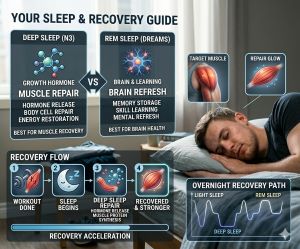
Sleep supports several processes involved in physical recovery, including tissue repair, energy restoration, and normal hormone regulation.
Every workout creates stress within your muscles. This is normal and part of the adaptation process. Training provides the stimulus, while recovery gives your body time to repair and adapt.
During sleep, your body:
- Supports tissue repair and adaptation
- Supports muscle protein synthesis
- Helps regulate hormones and immune function
- Helps restore energy and readiness for activity
What Happens During Sleep?
Sleep is an active biological process, not simply a period of rest. During sleep, the body regulates processes involved in tissue maintenance, metabolism, hormone function, and nervous-system recovery. These processes can support recovery after exercise, although recovery does not depend on one sleep stage or one hormone alone.
Muscle Repair During Sleep
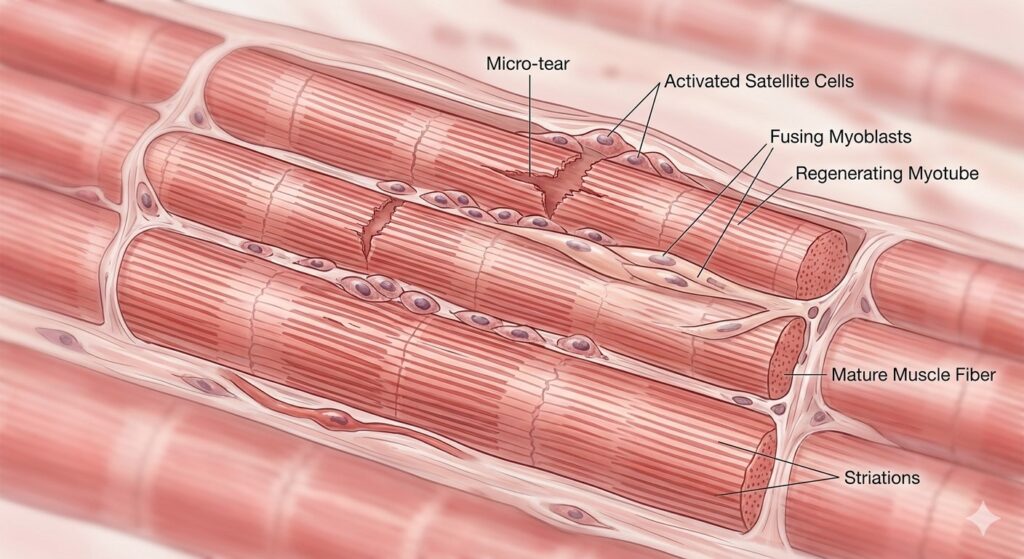
Sleep supports the physiological processes involved in tissue repair and adaptation after exercise. Adequate sleep is therefore one part of recovery, alongside appropriate training, nutrition, and rest. Research suggests that insufficient sleep can negatively affect some recovery processes, but sleep should not be viewed as the only factor determining muscle recovery.
Growth Hormone Release
Growth hormone secretion is closely linked to sleep, particularly slow-wave (deep) sleep. Growth hormone has roles in tissue maintenance, metabolism, and recovery, but it should not be presented as a direct guarantee of muscle growth. The practical takeaway is to prioritize sufficient, consistent sleep rather than trying to maximize one hormone or sleep stage.
Nervous System Recovery
Sleep also supports nervous-system and cognitive recovery. Poor or insufficient sleep can affect attention, reaction time, mood, motivation, and exercise performance. This may make training feel harder and can affect how well you perform, even when your muscles do not feel particularly sore.
How Much Sleep Do You Need for Muscle Recovery?
Most adults need 7 to 9 hours of sleep per night. People who train regularly may sometimes need more sleep during periods of higher training load, but there is no single recovery-specific number that works for everyone. Your sleep needs can vary with age, activity, health, and individual circumstances.
Deep Sleep and REM Sleep: Their Roles in Recovery
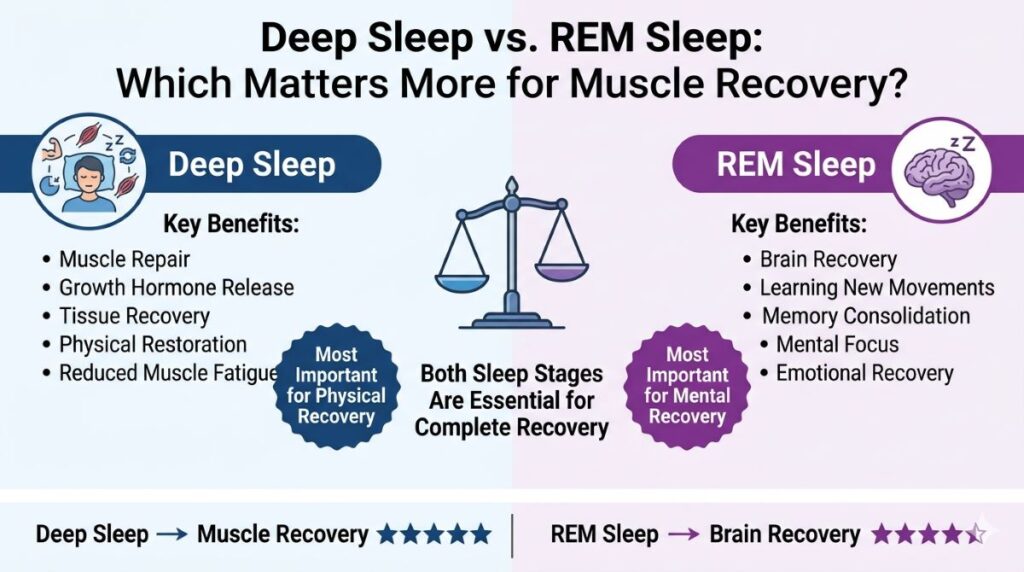
Deep sleep and REM sleep both play important roles in normal recovery. Deep sleep is associated with physical restoration and the release of growth hormone, while REM sleep supports processes such as learning, memory, and emotional regulation. Rather than treating one stage as more important, healthy recovery depends on getting enough overall sleep and maintaining normal sleep cycles.
Why Deep Sleep Matters
Deep sleep, also called slow-wave sleep, is associated with several important physiological processes, including growth hormone secretion, metabolic regulation, immune function, and aspects of physical recovery. Exercise can also influence the amount of slow-wave sleep a person gets, particularly after greater physical stress. However, recovery depends on overall sleep quality and duration rather than maximizing deep sleep alone.
- Supports normal growth hormone secretion
- Plays a role in physical restoration and tissue maintenance
- Supports metabolic and immune functions
Why REM Sleep Still Matters
REM sleep is important for normal brain function and may contribute to learning, memory, and emotional regulation. While deep sleep is more closely associated with physical restoration, REM sleep is also part of a normal sleep cycle. Good recovery therefore depends on getting enough overall sleep and maintaining normal sleep cycles, rather than focusing on one stage alone.
REM sleep helps with:
- Supports learning and memory
- Contributes to emotional regulation
- Supports normal brain and nervous-system function
Both stages are part of a normal sleep cycle, so overall sleep duration and continuity matter more than trying to maximize one stage.
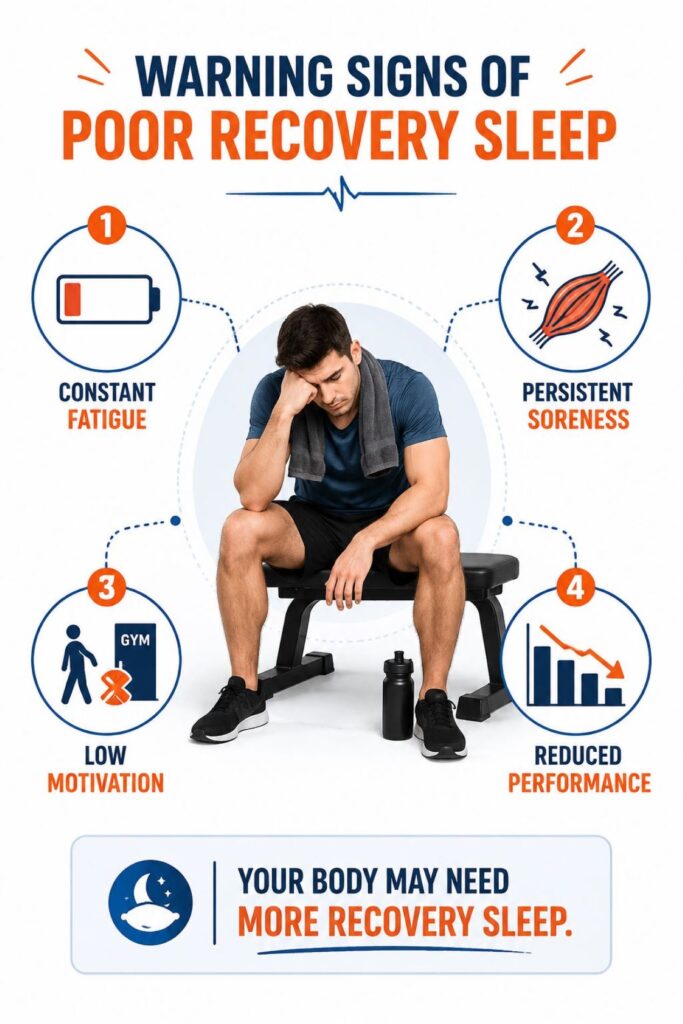
Signs You’re Not Getting Enough Recovery Sleep
Poor or insufficient sleep can affect energy, mood, exercise performance, and recovery. However, these signs are not specific to sleep and can also have other causes. If several of them persist despite getting enough time in bed, it may be worth looking at your sleep quality and overall recovery habits.
Watch for these common signs:
- Feeling unusually tired during the day
- Lower energy or motivation during workouts
- Exercise feeling harder than usual
- Difficulty concentrating or staying alert
- Taking longer to recover between workouts
Because these symptoms can have many causes, they should not be treated as proof of poor sleep on their own. Look at the overall pattern: if you are consistently tired, your workouts feel harder, or your performance is declining alongside poor or insufficient sleep, improving your sleep may be one useful part of your recovery strategy.
How to Improve Sleep Quality for Better Recovery
Sleep duration, continuity, and regularity all contribute to healthy sleep. If you want to support recovery, focus first on getting enough sleep consistently and creating habits that make it easier to fall asleep and stay asleep.
1. Follow a Consistent Sleep Schedule
Try to go to bed and wake up at roughly the same times each day, including weekends. A consistent schedule can help maintain your body’s sleep-wake rhythm and make it easier to get enough sleep regularly.
2. Create a Sleep-Friendly Environment
Keep your bedroom quiet, dark, and comfortably cool. Reducing noise, bright light, and other distractions can make it easier to fall asleep and stay asleep. A comfortable mattress and pillow can also help.
Your bedroom should be:
- Cool
- Dark
- Quiet
- Comfortable
3. Reduce Screen Exposure Before Bed
Try to use the hour before bed for quieter activities and reduce exposure to bright screens and artificial light. Light from TVs, computers, and phones can interfere with the body’s sleep-wake signals and may make it harder to fall asleep. Try avoiding screens 30–60 minutes before bedtime.
4. Limit Late-Day Caffeine
Caffeine can interfere with sleep, and its effects can last for several hours. If caffeine makes it harder for you to fall asleep or affects your sleep quality, avoid consuming it later in the day. The ideal cutoff varies between people because caffeine sensitivity and metabolism differ.
5. Build a Wind-Down Routine
Give yourself some quiet time before bed to transition from daytime activities to sleep. Relaxing activities such as reading, listening to calm music, taking a warm bath, or practicing relaxation techniques may help you wind down.
- Reading
- Light stretching
- Relaxation breathing
- Journaling
Frequently Asked Questions
How much sleep do adults need for muscle recovery?
Most adults need 7–9 hours of sleep per night. Individual needs can vary, especially with changes in activity, health, and training load.
Does poor sleep affect muscle recovery?
Poor or insufficient sleep can affect physical recovery, energy, and exercise performance. Consistently getting enough sleep is therefore an important part of a recovery routine.
Can naps help muscle recovery?
Naps can provide additional sleep and may help reduce fatigue and improve alertness, especially when nighttime sleep has been insufficient. However, naps should supplement regular nighttime sleep rather than replace it.
Does deep sleep matter for recovery?
Deep sleep is one part of normal sleep and is associated with physical restoration and growth hormone secretion. However, recovery depends on getting enough overall sleep rather than focusing on one sleep stage.
When should I seek help for ongoing sleep problems?
If you regularly have difficulty sleeping, wake frequently, or remain excessively tired despite getting enough time in bed, consider discussing the problem with a healthcare professional.
Medical Disclaimer
This content is for educational purposes only and should not be considered medical advice. Consult a qualified healthcare professional if you experience chronic sleep problems, persistent fatigue, sleep apnea symptoms, or ongoing recovery issues.
When to Consult a Healthcare Professional
Seek professional guidance if you experience:
- Chronic insomnia
- Excessive daytime sleepiness
- Suspected sleep apnea
- Persistent fatigue despite adequate sleep
- Ongoing recovery problems
Conclusion
Sleep is an important part of workout recovery, but it is only one part of the process. Most adults need 7–9 hours of sleep, and people who train regularly may sometimes need more depending on their training load and individual needs.
Rather than focusing on a specific sleep stage or trying to optimize recovery with complicated routines, focus on getting enough sleep consistently, maintaining a regular schedule, and addressing factors that interfere with sleep.
If you are consistently tired, your performance is declining, or you have ongoing sleep problems despite allowing enough time for sleep, consider discussing the issue with a healthcare professional.
References
Centers for Disease Control and Prevention. “About Sleep.” CDC.
https://www.cdc.gov/sleep/about/index.html
National Heart, Lung, and Blood Institute. “How Sleep Works: How Much Sleep Is Enough?” NIH.
https://www.nhlbi.nih.gov/health/sleep/how-much-sleep
National Heart, Lung, and Blood Institute. “Healthy Sleep Habits.” NIH.
https://www.nhlbi.nih.gov/health/sleep-deprivation/healthy-sleep-habits
Bonnar D, Bartel K, Kakoschke N, Lang C. “Sleep Interventions Designed to Improve Athletic Performance and Recovery: A Systematic Review of Current Approaches.” Sports Medicine. 2018;48(3):683–703.
https://pubmed.ncbi.nlm.nih.gov/29352373/
Coelho Silva A, Silva A, Edwards BJ, et al. “Sleep Extension in Athletes: What We Know So Far — A Systematic Review.” Sleep Medicine. 2021;77:128–135.
https://pubmed.ncbi.nlm.nih.gov/33352457/

I’m Mr. Baig, founder of Recover Better Lab. I create evidence-based fitness recovery content to help beginners recover smarter and build sustainable healthy habits.
Mission: My mission is to provide trustworthy, research-backed recovery and fitness content that helps people optimize their health, performance, and overall well-being.