
Reading Time: 8–10 minutes
Last Updated: August 2026
Quick Answer
The early signs of too much sitting can include stiffness after sitting, tight hips, lower-back discomfort, neck and shoulder tension, heavy or inactive-feeling legs, reduced ease of movement, and feeling physically drained despite spending much of the day inactive. These signs are not a diagnosis, but they can be useful signals that prolonged sitting is affecting how your body feels and moves.

Introduction
Have you ever stood up after a long meeting and felt as though your body needed a moment to catch up?
Your hips feel tight.
Your back feels stiff.
Your shoulders feel heavy.
Your legs may feel strangely inactive.
Even though you have not done anything physically demanding. Then you walk around for a few minutes and feel somewhat better. It is easy to dismiss these sensations as part of having a desk job, driving for several hours, studying, or spending an evening on the sofa.
But your body may be giving you information.
Sitting itself is not the problem. Sitting is a normal part of daily life. The concern is what happens when sitting occupies a large part of the day and movement becomes the exception rather than the interruption.
Sedentary behavior includes waking activities performed while sitting, reclining, or lying with low energy expenditure. Higher amounts of sedentary behavior are associated with several adverse health outcomes, which is why reducing prolonged sedentary time matters even for people who exercise.
The important question, however, is not simply whether sitting is “bad.” It is whether your body has already started telling you that you are sitting more than it is comfortably handling.
Table of Contents
What Too Much Sitting Does Before You Notice a Bigger Problem
The effects of prolonged sitting are not always dramatic. They can begin quietly.
A little stiffness when you stand.
A feeling that your hips need to loosen up.
A back that feels better after walking than after another hour in the chair.
Legs that feel heavy after spending most of the day inactive.
None of these experiences automatically means that something is wrong. They are signals, not diagnoses.
Prolonged sitting keeps large parts of the body relatively inactive while maintaining the body in a relatively fixed position. Over time, that combination can affect comfort, movement, and how easily you transition between sitting and moving.
Mayo Clinic notes that prolonged sitting is associated with health risks and can occur during desk work, driving, screen use, and other everyday activities. The earlier signs are often much less frightening than the long-term risks discussed in health articles. And that may be precisely why people ignore them.
Early Signs of Too Much Sitting
Stiffness Appears Almost Every Time You Stand Up
Perhaps the first sign is not pain. It is stiffness. You finish a meeting, push your chair back, and stand. For a few seconds, your body feels older than it did when you sat down.
Your hips need to straighten.
Your back feels tight.
Your knees or legs do not immediately feel ready to move.
After walking around, the sensation improves.
Occasional stiffness is normal. But when this becomes a predictable part of every long sitting period, it is worth noticing. Your body is spending extended periods in one position and then being asked to move immediately from stillness.
That transition can become increasingly noticeable when daily movement is limited.
Your Hips Feel Tight
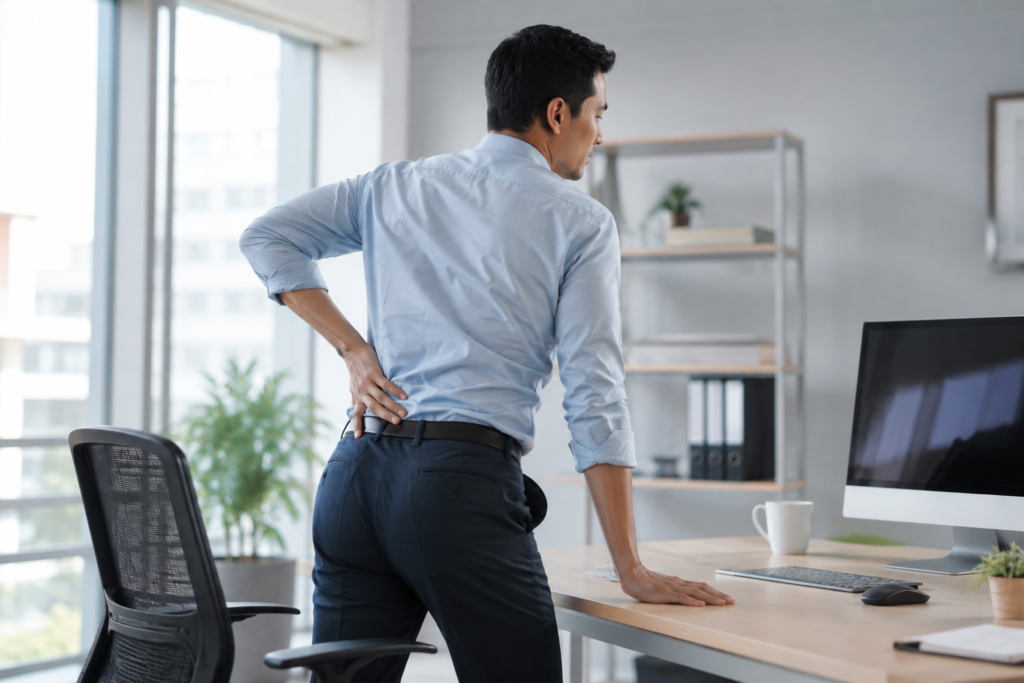
The hips are particularly affected by long periods of sitting because they remain in a flexed position for much of that time. You may notice this when you stand after working.
Your first few steps feel restricted.
You may feel as though you need to stretch before walking normally.
The sensation may disappear once you move.
That does not necessarily mean your hip muscles have become permanently tight. It may simply be a sign that your body has spent too much of the day in one position. Research and clinical sources commonly identify hip tightness and reduced mobility among the musculoskeletal effects associated with prolonged sitting.
Your Lower Back Complains More After Sitting Than After Moving
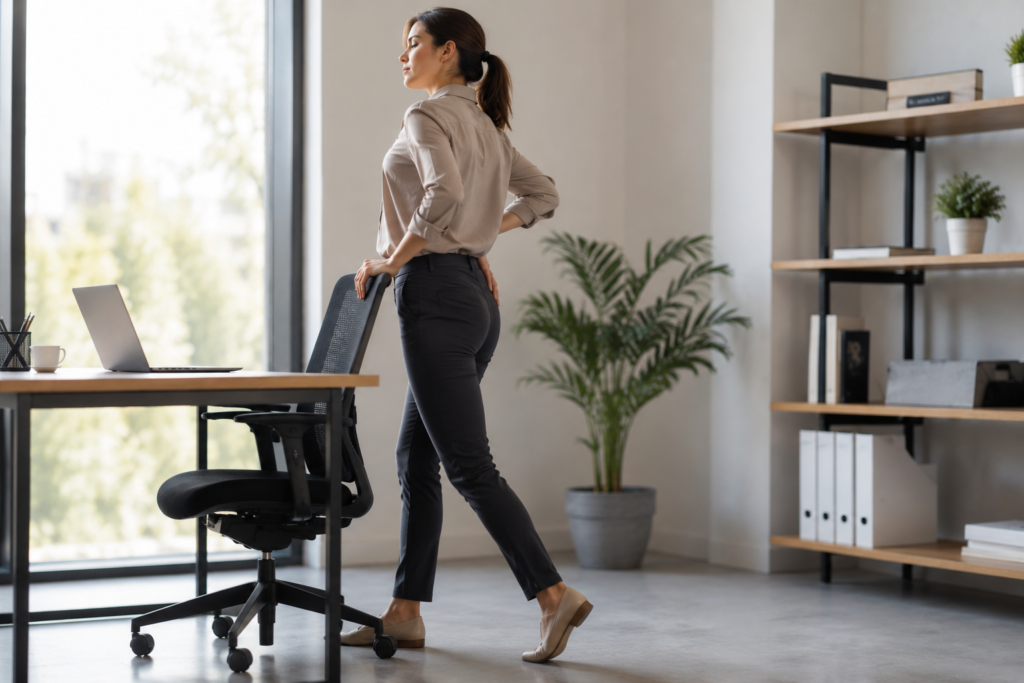
This can be confusing. You might assume that resting should make your back feel better. Yet after several hours at a desk, in a car, or on a sofa, your lower back may feel worse.
Then you get up.
You walk around.
And the discomfort begins to ease.
Prolonged sitting does not automatically cause every episode of back pain, and back discomfort has many possible causes. But a recurring pattern in which discomfort appears or increases after long periods of sitting is worth paying attention to.
The pattern matters more than one isolated episode.
Your Neck and Shoulders Feel Heavy
Your shoulders may gradually move forward as the day continues. Your neck may feel tight. You may find yourself rolling your shoulders or changing position repeatedly without consciously deciding to do so.
This is especially common when desk work keeps you in the same posture for long periods. The problem is not necessarily one “bad” sitting position. It may be the lack of variation. Your body is designed to move between positions.
Remaining in one position for too long can make ordinary movement feel increasingly uncomfortable. Prolonged sitting is associated with neck and shoulder stiffness and discomfort, particularly when posture is sustained for long periods.
Your Legs Feel Heavy or Inactive
Your legs do not have to hurt for you to notice a change. Sometimes they simply feel heavy. You stand after sitting for hours, and your legs feel as though they have been switched off. Walking may initially feel awkward or sluggish.
Long periods of sitting reduce the amount of time your leg muscles are actively contributing to movement. Over time, low activity can contribute to reduced muscle conditioning and endurance. This does not mean that every heavy-leg sensation is caused by sitting.
But if it repeatedly appears after long periods of inactivity, it is a useful signal to notice.

After prolonged inactivity, the legs may feel heavy or inactive when you finally stand and move.
Movement Starts Feeling Harder Than It Used To
This sign is subtler.
You can still walk.
You can still climb stairs.
You can still carry groceries.
But ordinary movement begins to feel less automatic.
You notice that standing after sitting takes more effort. The first few minutes of walking felt uncomfortable. A flight of stairs feels harder than you remember. Again, this does not prove that sitting is the cause. But when long sitting replaces large amounts of everyday movement, your body receives less practice at moving.
That matters.
A structured workout does not completely erase the fact that the rest of the day may be highly sedentary. WHO recommends that adults reduce sedentary time and replace it with physical activity of any intensity where possible.
You Feel Physically Drained Even Though You Barely Moved
This is one of the most confusing experiences.
You spent eight hours at a desk.
You did not exercise.
You did not lift anything heavy.
Yet you finish the day feeling exhausted.
Sitting does not mean the brain has stopped working. Work, concentration, decision-making, visual attention, and sustained mental effort can all contribute to fatigue. So not every form of end-of-day tiredness should be blamed on sitting.
But if you repeatedly feel physically heavy, stiff, and drained after long periods of sitting, while feeling better after moving around, the pattern is worth recognizing. It may be telling you that your day contains far less movement than your body needs.
Why These Signs Are So Easy to Ignore
The body rarely sends a notification saying, “You have been sitting too long.” Instead, the signals are ordinary.
A stiff back.
Tight hips.
Heavy legs.
A tired body.
Because these sensations are mild, they are easy to normalize. You tell yourself:
“I’ve been working all day.”
“I’m just getting older.”
“Everyone feels stiff after sitting.”
“Tomorrow I’ll move more.”
And then the next day looks almost the same. This is how small signals can disappear into routine. The issue is not that every small discomfort needs medical investigation. It is that recurring patterns deserve attention before they become normal.
Sitting Too Much Is Not the Same as Being Physically Inactive
This distinction matters. A person can exercise regularly and still spend most of the rest of the day sitting.
For example, someone might complete a 45-minute workout in the morning and then spend eight or nine hours sitting at work, followed by a long commute and several hours sitting at home. That person exercises. But they may also have a highly sedentary day. Physical activity and sedentary behavior are related, but they are not simply opposites.
WHO describes sedentary behavior separately from physical inactivity and recommends reducing sedentary time while increasing physical activity.
This is why one workout should not automatically be treated as a complete solution to an otherwise motionless day. The goal is not to make sitting the enemy. It is to make movement a normal part of the day rather than something that happens only during exercise.
Normal end-of-day tiredness vs. possible sitting-related signals
| What You Notice | What It May Mean | What It Does Not Necessarily Mean |
| Stiffness after sitting | Your body has spent a long time in one position. | A specific injury |
| Tight hips | Your hips have remained in a seated position for an extended period. | Permanent loss of mobility |
| Lower-back discomfort | Prolonged sitting may be contributing to discomfort. | Sitting is the only possible cause. |
| Heavy or inactive-feeling legs | Your legs have had little movement for an extended period. | A circulation disorder |
| Movement feels harder. | Your body may be getting less everyday movement than before. | That you are physically unfit |
What Your Body May Be Telling You
When several of these signs appear together, the useful question is not
“What disease do I have?”
It is:
“What has changed in the way my body feels when I sit, stand, and move?”
That question is more useful because symptoms alone cannot tell you their cause.
Perhaps your back feels stiff after three hours at your desk.
Perhaps your hips feel restricted when you stand.
Perhaps your legs feel heavy after a long drive.
Perhaps you are simply noticing that you feel much better after walking for a few minutes.
These observations do not diagnose anything. They give you information. And information is often where change begins.

A Pause for Reflection
Before moving on, think about your own day.
How many hours do you spend sitting?
How often do you stand because you need to, rather than because you intentionally changed position?
What does your body feel like when you first stand after a long period of sitting?
Does walking make you feel better?
Have you gradually accepted stiffness, heaviness, or discomfort as simply part of your normal day? None of these questions is a diagnosis. They are simply ways of noticing what your body has been telling you.
Conclusion: Notice the Signal Before It Becomes the Routine
Too much sitting does not always announce itself with serious symptoms. Often, the first signs are quieter.
Your hips feel tight.
Your back feels stiff.
Your shoulders become uncomfortable.
Your legs feel heavy.
Movement feels less natural.
You finish the day feeling physically drained despite barely moving.
These experiences can have many causes, so they should not automatically be blamed on sitting. But repeated patterns deserve attention.
The goal is not to fear your chair.
It is to notice when sitting has quietly taken up too much of your day. Your body does not need to wait for a major problem before you start listening to it.
Sometimes the earliest signal is simply this:
You feel better when you move.
That may be worth noticing.
Frequently Asked Questions
What are the early signs of too much sitting?
The early signs of too much sitting can include stiffness after sitting, tight hips, back or neck discomfort, heavy legs, reduced ease of movement, and physical fatigue after prolonged inactivity.
Can sitting too much cause back pain?
Prolonged sitting can contribute to back discomfort, but it is not the only possible cause of back pain. Persistent or severe pain should be assessed by a healthcare professional.
Can you sit too much even if you exercise?
Yes. A person can exercise regularly while still spending most of the day sitting. Physical activity and sedentary behavior are separate aspects of daily movement.
Is stiffness after sitting a sign of a problem?
Occasional stiffness is common. Repeated stiffness that consistently appears after prolonged sitting may be a useful signal to pay attention to, although it does not identify a specific medical condition.
How much sitting is too much?
There is no single universal number of hours that defines “too much sitting” for everyone. Current guidance emphasizes reducing sedentary time and replacing it with physical activity rather than relying on one rigid sitting-time threshold.
Medical Disclaimer
This article is intended for educational and informational purposes only. It is not a substitute for professional medical advice, diagnosis, or treatment. The signs discussed here are not diagnostic of a particular condition, and prolonged sitting is not necessarily the cause of every symptom.
When to Consult a Healthcare Professional
Speak with a qualified healthcare professional if pain, stiffness, weakness, numbness, or other symptoms are persistent, worsening, interfere with normal activities, or cannot reasonably be explained by your daily routine.
Seek urgent medical attention for sudden or severe symptoms, particularly significant one-sided leg swelling or pain, chest pain, sudden shortness of breath, or other symptoms that could indicate a serious medical problem.
Explore More Articles
Why Do I Feel Tired After Sitting All Day?
Psychological Effects of Long Hours at a Desk
References
World Health Organization (WHO). Physical Activity.
World Health Organization (WHO). WHO Guidelines on Physical Activity and Sedentary Behavior.
Mayo Clinic. Sitting risks: How harmful is too much sitting?
Silva H, Ramos PGF, Teno SC, Júdice PB. The Impact of Sit-Stand Desks on Full-Day and Work-Based Sedentary Behavior of Office Workers: A Systematic Review. Human Factors, 2025.

I’m Mr. Baig, founder of Recover Better Lab. I create evidence-based fitness recovery content to help beginners recover smarter and build sustainable healthy habits.
Mission: My mission is to provide trustworthy, research-backed recovery and fitness content that helps people optimize their health, performance, and overall well-being.