
Reading Time: 8–10 minutes
Last Update: August 2026
Why Understanding, Not Fear of Menopause, Is the Best Place to Begin When Approaching One of the Most Natural Transitions in a Woman’s Life?
Key Takeaway
Many women encounter fear of menopause through stories before they experience it themselves. Long before physical changes begin, fear of menopause can be shaped by conversations about symptoms, hormonal changes, difficult experiences, and uncertainty.
Menopause is a natural biological transition, but that does not mean every woman experiences it in the same way. Some experience few changes, while others may experience hot flashes, disrupted sleep, mood changes, or difficulty concentrating that can affect daily life.
This article is not about denying those experiences. It is about asking whether fear has become louder than understanding and why that distinction matters.
Introduction
Some women meet menopause long before it ever arrives. Not through their bodies. Through stories. A conversation with a friend. A relative describing difficult years. A social media post listing everything that might happen. Hot flashes. Sleepless nights. Mood changes. Irregular periods.
Some women begin to fear what they have only heard about. Not because they are experiencing those changes themselves, but because they have heard about them often enough to begin imagining what their own future might look like.
A podcast can leave more questions than answers. An article has a headline frightening enough to make us wonder whether the same future is quietly waiting for us.
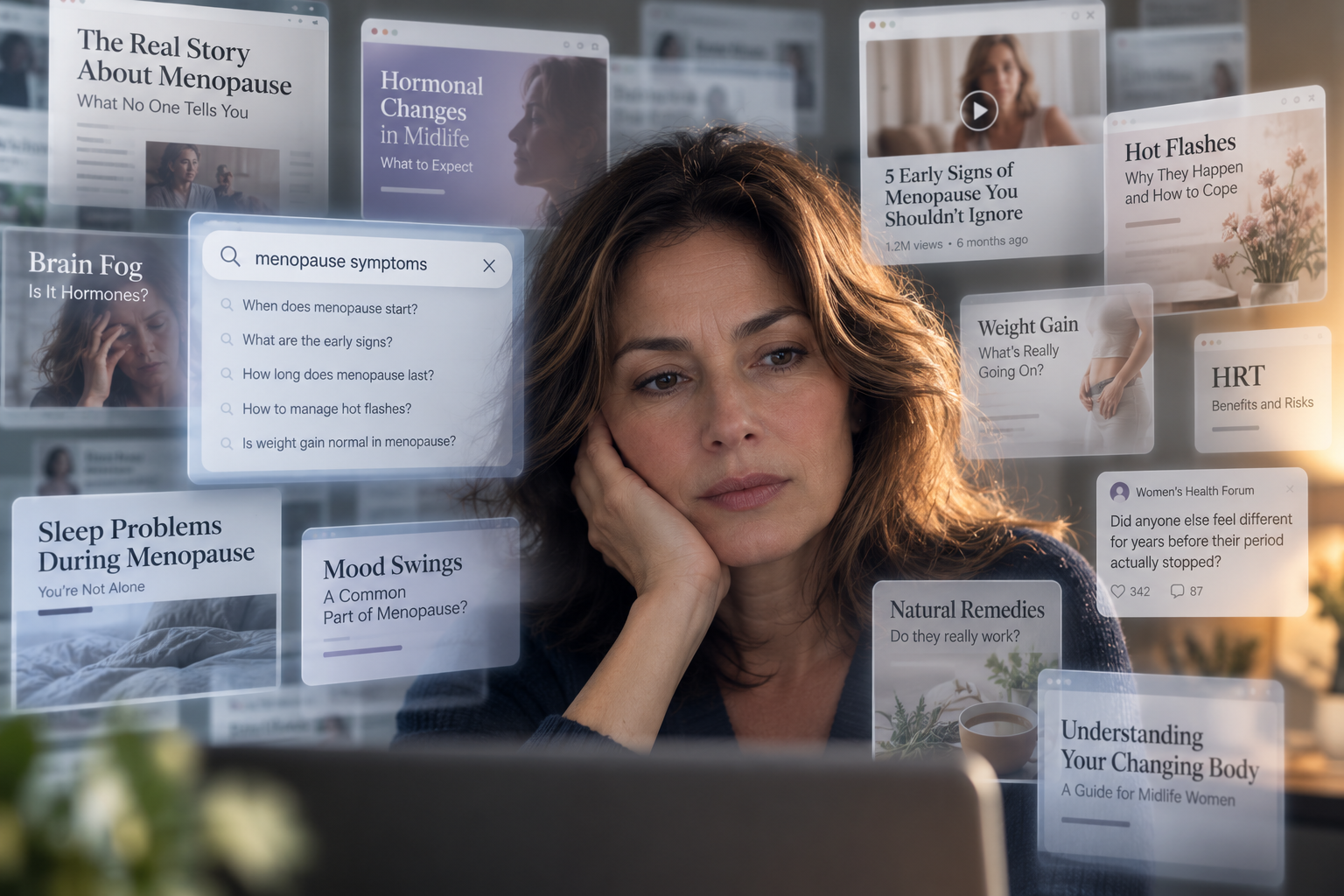
Over time, these repeated stories can influence the way menopause is imagined before it is experienced. Recently, while speaking with a friend who works closely with women experiencing menopause, she shared an observation that stayed with me.
“When women talk about menopause,” she said, “they often talk about fear before they talk about menopause itself.” That sentence felt true. And it raises an important question: How does something that is a natural biological transition become frightening long before it even begins?
We are learning more about menopause than previous generations did. Medical research continues to develop, conversations are becoming more open, and women have greater access to health information than ever before.
This is progress. But more information does not always create more understanding. Sometimes, it creates more noise.
The more we hear about other women’s experiences, the easier it becomes to collect pieces of those experiences without realizing that they belong to different women, different bodies, and different circumstances.
One woman speaks about sleepless nights. Another talks about anxiety. Someone else describes years of exhaustion. None of these experiences are necessarily untrue.
But when they arrive one after another, they can begin to create a picture in our minds long before our own experience has even begun.
Without noticing, we may stop preparing to understand menopause. We start preparing to fear it.
So perhaps the better question is not “What symptoms will I get?” Perhaps it is: “What should I understand before I begin imagining what menopause will be like for me?”
This is not a guide to every possible symptom. It is not a treatment plan. It is an invitation to pause. To separate what we know from what we assume.
And to ask whether the picture we carry in our minds truly belongs to us or whether it has been shaped by everything we have heard along the way.
Table of Contents
Why Does Fear Of Menopause Feel Before It Even Begins?
For many women, menopause becomes familiar long before it becomes personal.
It enters conversations through mothers, sisters, relatives, friends, colleagues, social media, articles, podcasts, and health discussions.
Some of that information is reliable. Some reflect individual experience. And some are presented without enough context.
The difficulty is that these different sources can eventually blend together.
We may hear about one woman’s difficult experience and unconsciously begin treating it as a preview of our own.
We hear that someone experienced severe hot flashes. We hear that someone else struggled with sleep. Another woman talks about mood changes. Another describes feeling unlike herself.
Again, these experiences can be real. But one woman’s experience does not automatically become another woman’s future.
Menopause and perimenopause can affect women very differently. Some women have few symptoms, while others experience symptoms that have a significant effect on everyday life.
That variation matters.
Because when we hear only the most difficult stories, we can begin to imagine menopause as one predictable experience rather than a transition that can look different from person to person.
This is where fear can quietly settle in.
A restless night becomes something to worry about. A forgotten word becomes something to interpret. A change in mood becomes something to monitor.
Instead of simply noticing what is happening, we may begin searching for evidence that confirms what we have already been told to expect.
That is an important difference.
Preparation is not the same as worry.
Preparation creates awareness. Worry creates assumptions. Preparation leaves room for uncertainty. Worry tries to predict the future. Before menopause asks anything of our bodies, perhaps we should ask something of ourselves:
Are we trying to understand fear of menopause, or are we unknowingly training ourselves to fear it?
What Is Fear of Menopause, and What Is It Not?
One reason menopause can feel overwhelming is the way we imagine it. Many people picture menopause as a sudden moment: one day, everything changes. But the transition is usually more gradual.
Menopause itself is not a disease. It is a natural biological stage associated with the end of the reproductive years. Natural menopause is defined retrospectively after 12 consecutive months without a menstrual period when there is no other obvious cause.
Before menopause, many women go through perimenopause, the transition leading up to the final menstrual period.
During this time, menstrual cycles can change, and some women experience symptoms as their bodies transition toward menopause.
This distinction matters. Menopause is not simply a switch that turns everything off overnight. It is part of a broader transition. Understanding that changes the picture. Instead of imagining one dramatic event, we begin to see a process unfolding over time.
And that leaves room for something fear often takes away: perspective.
Understanding does not remove uncertainty. But it gives uncertainty somewhere to sit.
When we do not understand something, our minds tend to fill the gaps. Sometimes those gaps are filled with information. Sometimes they are filled with assumptions. And sometimes they are filled with fear.
From Fear to Understanding
Fear has a particular way of dealing with the future. It asks us to live tomorrow before tomorrow arrives. When we believe something difficult is ahead, we can become more alert to anything that appears to confirm it.
We become hyper-aware. We start interpreting. We search for signs.
This article is not asking anyone to dismiss difficult menopause experiences.
Those experiences are real, and some women need medical support when symptoms affect their health or daily life.
The question is simpler: Should fear be the first voice we listen to?
There is a difference between learning about menopause and learning to fear it. One creates space for understanding. The other can make every possibility feel like a prediction.
Today, we have access to more information than ever before. But not every piece of information deserves the same amount of trust or the same amount of space in our minds.
Some information educates. Some reflect personal experience. Some provide useful medical guidance. And some simply make us more anxious.
The real skill is not consuming more information.
Neither one can tell us exactly what our own experience will be.
A reliable medical source can tell us what menopause is, what changes may occur, and when professional advice may be appropriate. Another woman’s story can tell us what happened to her. Neither one can tell us exactly what our own experience will be.
That distinction is easy to lose. But it is important.
So ask yourself:
After learning about fear of menopause:
Do I understand it more clearly, or do I simply have more things to fear?
Reliable information should create clarity. Fear creates noise. Understanding allows observation. Fear pushes prediction. Confidence does not come from knowing exactly what will happen.
It comes from knowing enough to face what happens without assuming the worst beforehand.
A Pause for Reflection
Before moving on, consider what you have already been carrying about menopause. How much of it comes from your own experience? How much comes from someone else’s? How much comes from medical information? And how much comes from stories you have heard repeatedly?
That is where awareness can become more useful than anticipation.
There is nothing wrong with wanting answers. And there is nothing wrong with taking difficult experiences seriously. But preparation becomes different when it is built entirely around fear.
Perhaps the question is not “How do I make sure menopause does not become difficult?”
Perhaps, before that question, there is another one: “How can I understand what is happening without assuming I already know how it will feel?”
That is where awareness becomes more useful than anticipation. And where understanding can begin to replace fear.
Conclusion: Understanding Menopause Beyond Fear

Menopause has always been part of human life. What has changed is how we talk about it. Today, women are exposed to more conversations about menopause than ever before.
That visibility matters. It can reduce silence. It can help women recognize when something deserves attention. It can make it easier to seek appropriate support. But more conversation does not automatically mean better understanding.
Sometimes, it simply means more information competing for our attention. This article was never about denying difficult menopause experiences. It was about asking a different question: Should fear of menopause come first or understanding?
Some may be accurate but simply not relevant to a woman’s own experience. Understanding allows us to meet it when it does, without assuming that someone else’s experience has already written our story.
For many women, expectations about menopause begin long before menopause itself. Those expectations may come from family, friends, media, social conversations, or personal stories. Some may be helpful. Some may be frightening. Some may be accurate but simply not relevant to their own experience.
Perhaps it needs a different kind of attention.” Perhaps it needs a different kind of attention. One that begins not with panic, but with perspective. Not with assumptions, but with understanding.
Before you move on, pause for a moment and ask yourself: Am I preparing to understand menopause, or am I preparing to fear it? Because the answer may shape the way you approach this transition long before it begins.
Frequently Asked Questions
1. Should I be afraid of menopause?
Menopause is a natural biological stage, not a disease. Experiences vary widely, and some women have few or no troublesome symptoms. Understanding what menopause involves can help you approach the transition with greater clarity rather than assuming the worst.
2. Should I understand menopause before looking for treatment?
Understanding what menopause and perimenopause involve can help you recognize changes, ask informed questions, and decide when to seek professional advice. Treatment decisions should be based on your individual symptoms, health, and circumstances rather than fear alone.
3. Why do so many women fear menopause?
Women often hear about menopause long before experiencing it themselves. Stories from family, friends, social media, and online discussions can shape expectations. When difficult experiences are repeated without context, they can make menopause seem more predictable and frightening than it actually is.
4. Where can I find reliable information about menopause?
Look for information from established medical and public health organizations. Their guidance can help you understand menopause, symptoms, diagnosis, and management more reliably than personal stories or unsourced online claims.
5. Can fear make menopause feel more overwhelming?
Understanding the transition can provide a more balanced way to approach uncertainty. This is a small refinement and avoids implying that understanding necessarily produces a particular emotional outcome.
Medical Disclaimer
This article is intended for educational and informational purposes only. It is not a substitute for professional medical advice, diagnosis, or treatment. If you have concerns about changes in your menstrual cycle, menopause or perimenopause symptoms, or your overall health, consult a qualified healthcare professional.
References
World Health Organization. “Menopause.” 16 October 2024.
https://www.who.int/news-room/fact-sheets/detail/menopause/
NHS. “Symptoms of menopause and perimenopause.” Reviewed 19 May 2026.
https://www.nhs.uk/conditions/menopause-and-perimenopause/symptoms/
National Institute for Health and Care Excellence (NICE). “Menopause: identification and management (NG23).” Updated 15 April 2026.
https://www.nice.org.uk/guidance/ng23/
American College of Obstetricians and Gynecologists (ACOG). “The Menopause Years.”
https://www.acog.org/womens-health/faqs/the-menopause-years
The Menopause Society. “Symptoms.”
https://menopause.org/patient-education/menopause-topics/symptoms
Continue Reading
How Long Sitting Changes Your Posture Without You Realizing It
Next in the Zonish Menopause Series
Why No Two Women Experience Menopause in the Same Way Every woman’s menopause journey is different. In the next article, we’ll explore why comparing your experience with someone else’s can sometimes create more fear than understanding and why your own body deserves to be understood on its own terms.

Zonish is a writer exploring the human realities behind life transitions, emotional patterns, personal responsibilities, and the experiences that are often difficult to explain. Her work focuses on understanding before advice—creating space for readers to recognize what they may be experiencing and reflect on it with greater clarity.