

Estimated reading time: 9 minutes
Last reviewed: August 2026
How long sitting changes your posture depends on how consistently you spend your day sitting. Over weeks, months, and years, the body gradually adapts to prolonged sitting by changing muscle activity, joint positioning, and movement habits. Because these changes happen slowly, many people don’t notice them until their posture feels different or discomfort begins. Most posture changes don’t begin with pain. They begin with familiarity.
One morning, you sit down exactly as you did yesterday. You lean toward your screen, rest your forearms on the desk, and lose yourself in work. Nothing feels different because nothing dramatic has happened. Tomorrow looks much the same. So does next week.
Months pass without your posture asking for attention. Then, one day, a photograph catches you off guard. You notice your shoulders sitting a little lower than you remember. Your head seems slightly farther forward. Standing tall feels strangely unfamiliar, even though it once felt effortless.
That is often how long sitting changes your posture, not through one long day at your desk, but through thousands of ordinary hours that quietly teach your body what “normal” feels like. For office workers, drivers, students, designers, and remote professionals, sitting has become an unavoidable part of daily life. The body responds to that reality in the same way it responds to every repeated experience: it adapts.
The important thing to understand is that adaptation isn’t the same as injury. Most posture changes begin long before discomfort appears. They develop gradually, making them easy to live with and even easier to overlook.
How Long Sitting Changes Your Posture
People often ask how long sitting changes your posture, expecting a simple answer measured in weeks or months. The body doesn’t work that way. It doesn’t follow a calendar. It follows repetition. Every day, your brain and body pay attention to the positions you spend the most time in. The more often a position is repeated, the more familiar it becomes. Over time, familiar movements require less effort because your body has learned them.
The same process helps you drive a car without thinking about every movement or type on a keyboard without looking at each key. Posture adapts through repetition too. If much of your day is spent sitting with your hips bent, your shoulders reaching forward, and your attention focused on a screen, your body gradually becomes more efficient in that position. Not because it believes that position is perfect, but because it’s the one it practices most often.
The body has no opinion about whether a posture is good or bad. It simply responds to repeated demand. That’s why posture is less like a photograph and more like handwriting. It reflects what you practice every day, often without realizing you’re practicing it at all.
Why You Rarely Notice the Changes
One of the reasons posture changes can be so surprising is that the brain isn’t very good at noticing tiny changes repeated over long periods. We easily notice sudden events.
A haircut.
A sprained ankle.
A new pair of glasses.
But gradual changes rarely attract the same attention. Yesterday’s posture looked almost identical to today’s. Today’s look is almost identical to tomorrow’s. Each individual change was too small to stand out. Months later, those tiny differences have quietly accumulated into something you can finally see.
That’s why posture often reveals itself in unexpected moments rather than during work itself. Perhaps an old family photograph makes you pause. Maybe you catch your reflection while walking past a shop window or someone comments that you seem to lean forward more than you used to.
The posture didn’t suddenly change that day. That was simply the day you noticed what had been changing all along. Recognition like this isn’t about finding faults. It’s about becoming aware of patterns that have slowly become familiar.
What Changes First When You Sit for Long Hours?
Before posture looks different, it usually feels different.
Not painful.
Not alarming.
Just… different.
You may find yourself leaning on the desk without realizing it. Standing up might come with an automatic stretch. Sitting upright through an entire meeting starts feeling like work instead of something that happens naturally.
These are often the quiet signs that your body has been adapting long before you notice visible changes. The body rarely changes everything at once. Instead, it makes small adjustments wherever repeated sitting asks the most of it. Your head gradually moves forward. Think about how often your attention is slightly in front of your body.
A laptop screen.
A second monitor.
A notebook.
A mobile phone.
None of these positions seem extreme on their own. But when they become normal every day, your head gradually spends more time in front of your shoulders than directly above them. The shift is usually so small that you don’t notice it happening. Instead, you notice it later, when an old photograph reminds you that your posture once looked different. Your shoulders begin following your routine. Your shoulders don’t suddenly become rounded. They follow the work you ask them to do.
Typing.
Writing.
Using a mouse.
Scrolling through a phone.
Driving.
Preparing meals.
Many daily activities happen with the arms in front of the body. When that position is repeated hour after hour, day after day, the shoulders slowly become more accustomed to resting there. It’s less a sign of weakness than a reflection of repetition. Your upper back moves less than used to; the upper back is designed to rotate, extend, and move throughout the day. But prolonged sitting often asks it to do something very different.
Stay still. Hour after hour, movement variety begins to disappear. The issue isn’t simply sitting; it’s spending so much time in one position that the body has fewer opportunities to explore other positions.
Over time, stillness itself becomes familiar. Your Hips Quietly Set the Foundation Most people look at their shoulders when thinking about posture. Few think about their hips. Yet every time you sit, your hips remain bent for long periods. Since the pelvis forms the foundation of the spine, small adaptations here can gradually influence everything above it.
Rather than viewing posture as separate body parts that need fixing, it helps to think of it as one connected system. A subtle change in one area often influences another. Your Body Starts Preferring Familiar Positions Perhaps the biggest change isn’t in a single muscle or joint. It’s preference. Without realizing it, your body begins choosing the positions it knows best.
Lean on the same arm.
Shift your weight onto the same hip.
Sit in the same way.
Stand in the same way.
These habits rarely develop overnight. They’re the result of countless ordinary decisions repeated so often that they no longer feel like decisions at all. This is why how long sitting changes your posture isn’t only about what happens while you’re sitting. It’s about how those sitting habits gradually begin influencing the way you stand, walk, and move long after you’ve left your chair.
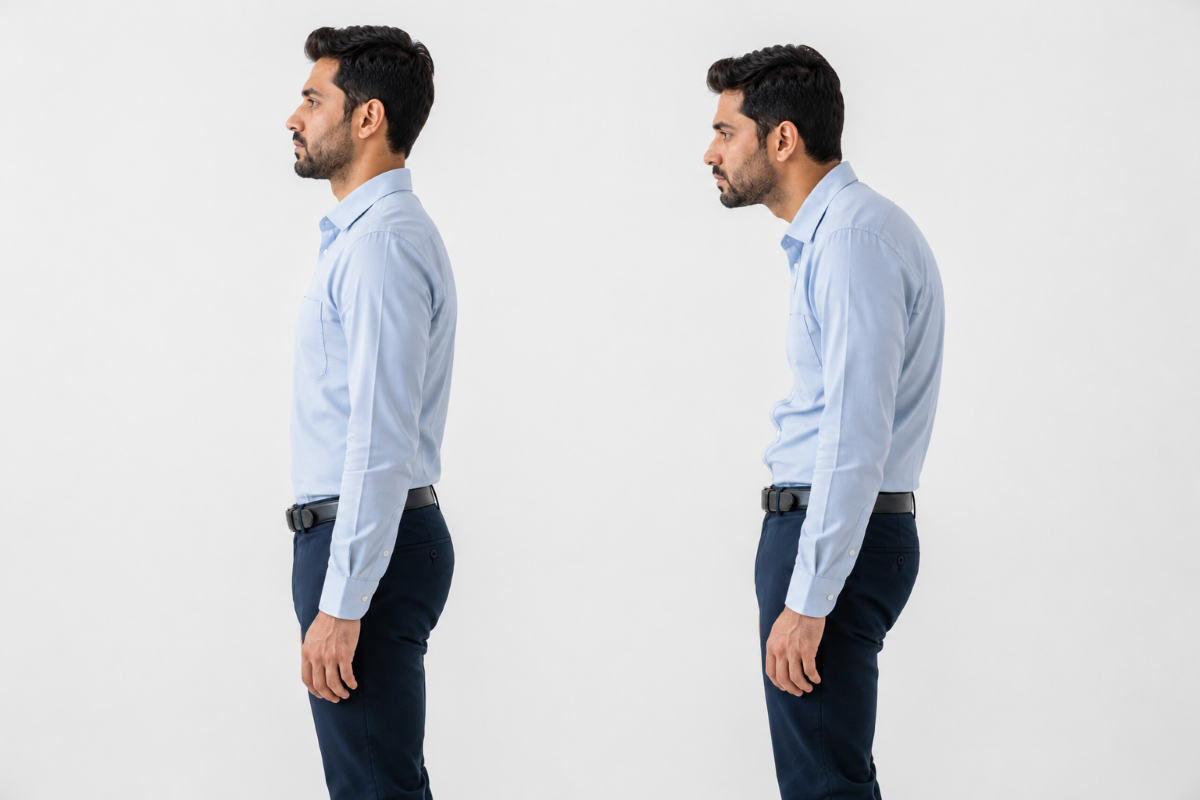
Your Body Is Adapting, Not Trying to Work Against You
When people first notice their posture changing, it’s easy to blame themselves. They assume they’ve become lazy.
Or weak.
Or careless.
But those explanations overlook something important. Your body has been solving the problem you gave it. If your daily routine asked it to sit for eight hours, it became better at sitting for eight hours. If your work required you to lean toward a screen every day, it gradually becomes more comfortable in that position.
That isn’t failure. It’s adaptation.
The remarkable thing about the human body is that it is always learning from repetition. Every ordinary day contributes to a tiny lesson. Most of those lessons happen so quietly that we never notice them. Understanding this changes the conversation. Instead of asking,
“What’s wrong with my posture?”
You begin asking,
“What has my body been practicing every day?”
That question doesn’t assign blame. It creates understanding. And understanding is often the first step toward making different movement choices tomorrow.

When Should You Pay Attention?
Not every posture change is a reason to worry. The human body naturally changes throughout life. Age, occupation, hobbies, previous injuries, and daily routines all influence how we move and stand. A slightly different posture doesn’t automatically mean something is wrong. However, it’s worth paying attention when gradual posture changes begin affecting the way you move or feel. You may notice that:
- Standing for short periods feels more tiring than it used to.
- Your neck or upper back feels stiff most mornings.
- You avoid certain movements because they feel uncomfortable.
- You frequently shift your weight while standing.
- Friends or family comment that your posture looks different.
- You feel less comfortable walking or standing for longer periods.
These observations aren’t meant to diagnose a condition. They’re simply signals that your body may have adapted to the routines it experiences every day. The earlier you recognize these patterns, the easier it becomes to introduce more movement variety into your day before those habits become even more deeply established.
A Pause for Reflection:
Before thinking about changing your posture, take a moment to notice it. Ask yourself:
- When was the last time I spent an hour without sitting?
- Does standing upright feel natural or surprisingly tiring?
- Have I compared my posture today with photographs from five or ten years ago?
- Do I change positions throughout my workday, or do I remain in the same position for hours?
- Am I reacting to discomfort only after it appears, or am I paying attention to the quieter changes that came first?
There are no right or wrong answers. These questions aren’t designed to judge your posture. They’re designed to help you notice what has slowly become normal. Sometimes awareness is the most important change because it shapes the decisions you make long before discomfort begins.

Evidence Summary
1. Prolonged Sitting Changes Muscle Activity and Posture
Key finding:
Long periods of sitting reduce activation of the gluteal and trunk muscles while increasing sustained activity in muscles around the neck and shoulders. Over time, the body adapts to these repeated positions, contributing to postural changes rather than a sudden structural shift.
2. The Body Adapts to Repeated Positions
Key finding:
Human tissues—including muscles, tendons, fascia, and the nervous system—adapt to the positions and movements they experience most frequently. Repeated sitting encourages the body to become more efficient in that posture.
3. Forward Head Posture and Rounded Shoulders Are Common in Sedentary Workers
Key finding:
Studies consistently associate prolonged desk work and sedentary behavior with increased forward head posture, rounded shoulders, and altered spinal alignment, particularly when sitting posture is maintained for extended periods.
4. Regular Movement Helps Reduce the Effects of Prolonged Sitting
Key finding:
Clinical guidance emphasizes interrupting prolonged sitting with regular movement because changing position reduces continuous loading on muscles and joints. Movement variety is more important than maintaining one “perfect” posture all day.
Conclusion
How long sitting changes your posture isn’t measured by a single day at your desk. It’s measured by thousands of ordinary hours that slowly teach your body what “normal” feels like. The good news is that awareness begins the moment you notice those patterns. Once you recognize them, your daily movement choices can begin shaping a different normal.
Frequently Asked Questions
Can sitting too long permanently change your posture?
Prolonged sitting can contribute to gradual postural adaptations, but many changes are influenced by daily movement habits and can improve over time. Whether changes are permanent depends on factors such as age, overall health, activity levels, and underlying medical conditions.
How long does sitting change your posture?
There isn’t one fixed timeline. How long sitting changes your posture depends on how often, how long, and how consistently you spend your day sitting, as well as how much movement you include between sitting periods.
Can posture change without pain?
Yes. Many people experience gradual posture changes long before they notice discomfort. This is one reason those changes often go unnoticed until they become visible or begin affecting everyday movement.
Why do my shoulders become rounded after years of desk work?
Desk work often places your arms and shoulders in front of your body for extended periods. Over time, your body adapts to these repeated positions, which may contribute to a more rounded shoulder appearance.
Can posture improve after years of sitting?
Many people can improve movement quality and postural habits by introducing greater movement variety into their daily routine. Improvement is usually gradual and depends on individual circumstances rather than a quick fix.
Medical Disclaimer
This article is for educational purposes only and should not be considered medical advice. If you experience persistent pain, significant posture changes, or symptoms that interfere with daily activities, consult a qualified healthcare professional.
References
World Health Organization. WHO Guidelines on Physical Activity and Sedentary Behavior: Web Annex Evidence Profiles.
World Health Organization. WHO Guidelines on Physical Activity and Sedentary Behavior
World Health Organization. Physical Activity Fact Sheet.
O’Sullivan P, Caneiro JP, O’Keeffe M, et al. Facts and Myths Regarding Posture and Spinal Health. Journal of Orthopedic & Sports Physical Therapy. 2019;49(8):562–564.

I’m Mr. Baig, founder of Recover Better Lab. I create evidence-based fitness recovery content to help beginners recover smarter and build sustainable healthy habits.
Mission: My mission is to provide trustworthy, research-backed recovery and fitness content that helps people optimize their health, performance, and overall well-being.