
Reading Time: 10–12 minutes
Last Reviewed: July 11, 2026
Quick Answer
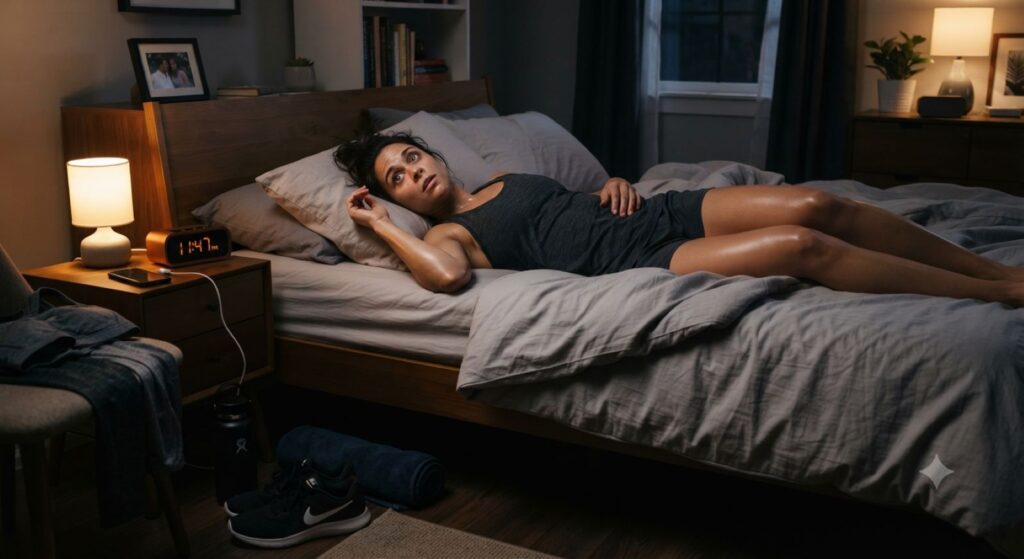
Wondering, why can’t I sleep after a workout?. Difficulty sleeping after exercise is commonly caused by temporary activation of your nervous system, elevated body temperature, increased heart rate, workout timing, caffeine or pre-workout supplements, or incomplete recovery. Most people experience this occasionally after an intense or late workout, and it usually improves as the body returns to its resting state. However, if poor sleep becomes frequent or is accompanied by persistent fatigue, declining performance, or other symptoms concerning, it may indicate that your recovery needs more attention or that another health condition is contributing.
Key Takeaways
- Feeling physically tired doesn’t always mean your brain is ready for sleep.
- Exercise temporarily increases alertness before recovery begins.
- High-intensity evening workouts affect people differently.
- Body temperature and heart rate need time to return toward resting levels.
- Recovery nutrition, hydration, and stimulant use can influence sleep quality.
- One poor night of sleep after exercise is usually not a cause for concern.
- Persistent sleep problems deserve a closer look at your overall recovery and, in some cases, medical evaluation.
Introduction
Why Can’t I Sleep After a Workout?
You expected your workout to leave you pleasantly tired. Instead, you finish exercising, shower, eat dinner, and climb into bed only to find yourself wide awake. Your body feels exhausted, but your mind doesn’t seem ready to sleep.
If this sounds familiar, you’re not alone. Many people occasionally have trouble sleeping after exercise, especially after an intense or late-evening workout. In most cases, this doesn’t mean exercise is harming your sleep. Instead, it usually means your body is still transitioning from performance mode into recovery mode.
Understanding why you can’t sleep after a workout begins with understanding recovery, not just sleep. Exercise temporarily changes your nervous system, body temperature, hormone levels, heart rate, and energy demands. If those systems haven’t settled by bedtime, falling asleep may take longer even though your muscles feel tired.
The good news is that post-workout sleeplessness is often temporary and manageable. The key is learning how to recognize what your body is telling you so you can make better recovery decisions rather than assuming you need to stop exercising.
Table of Contents
Why Can’t I Sleep After a Workout?
At first, it seems contradictory.
Exercise requires energy. It challenges your muscles, increases your breathing, and leaves you feeling physically worn out. It would seem logical that sleep should come easily afterward. But your body doesn’t switch directly from exercise to deep rest. Instead, it moves through a gradual recovery process. During this transition, some systems begin calming down quickly, while others remain active for a while longer. If you try to sleep before this transition is complete, your brain may still receive signals that your body isn’t fully ready for sleep.
Understanding this difference explains why someone can feel exhausted while simultaneously feeling too alert to fall asleep.
Your body can be tired while your nervous system is still alert
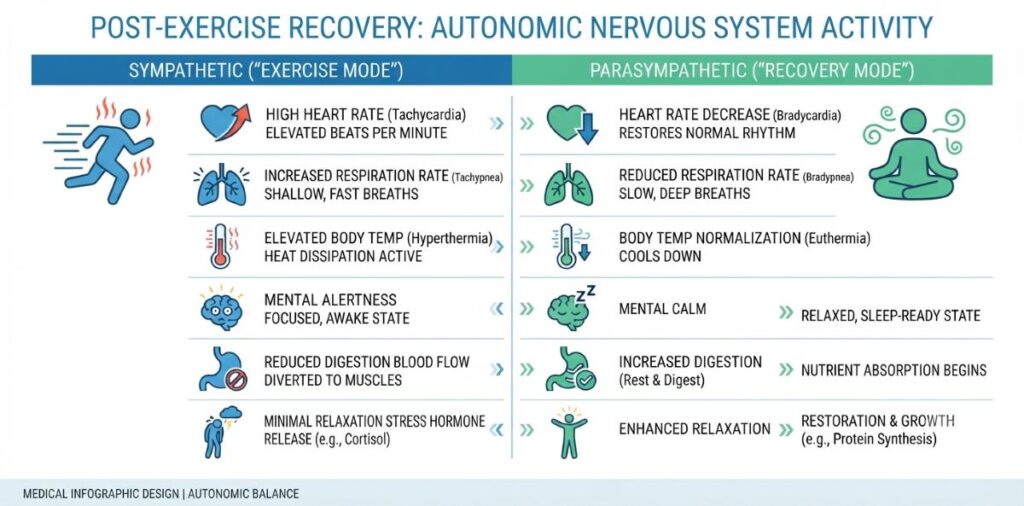
Exercise places your body in a highly active state. During physical activity, your sympathetic nervous system, often called the “fight or flight” response, helps prepare you for movement. Your heart pumps faster, breathing becomes deeper, muscles receive more blood flow, and stress hormones help support physical performance.
These changes are helpful during exercise because they improve your ability to meet physical demands.
The challenge comes afterward. Recovery depends on gradually shifting toward parasympathetic activity, sometimes called the “rest and digest” state. This shift allows heart rate to slow, body temperature to fall, digestion to resume normally, and sleep-promoting processes to become more active. For some people, especially after vigorous evening exercise, this transition simply takes longer than expected.
Why feeling exhausted isn’t the same as being ready to sleep
Physical fatigue and sleep readiness are not identical. Your muscles may be depleted from lifting weights or running several miles, but your nervous system may still be processing the demands of the workout. Imagine driving a car at highway speed. Even after taking your foot off the accelerator, the vehicle doesn’t stop immediately. Momentum carries it forward before it gradually slows.
Your body behaves in much the same way after exercise. The workout ends, but the physiological effects continue for some time afterward. Until those effects begin settling, falling asleep may feel surprisingly difficult.
Recovery Insight
Finishing a workout is not the same as finishing recovery. Recovery begins when your body can gradually shift from performance mode back into a resting state.
What Happens Inside Your Body After Exercise?
Understanding the recovery process makes post-workout sleeplessness much easier to explain. Several systems recover simultaneously, each on its own timeline.
The sympathetic nervous system remains active
During exercise, your brain prioritizes movement and performance. This includes increasing alertness, improving reaction time, and directing energy toward your muscles. These changes don’t disappear the moment your workout ends. The harder or longer the workout, the longer it may take for your nervous system to settle.
High-intensity interval training, heavy resistance training, competitive sports, and vigorous evening workouts are more likely to produce this lingering activation than light or moderate exercise. For many people, this effect lasts only a short period. For others, particularly those exercising close to bedtime, it may delay sleep onset.
Your heart rate needs time to recover
Heart rate recovery begins almost immediately after exercise, but it isn’t instantaneous. If your heart rate remains elevated for an extended period, your body may continue interpreting this as a sign that it should remain alert rather than preparing for sleep. Cool-down activities, gentle walking, and gradual recovery can help your cardiovascular system transition more smoothly than stopping abruptly after intense exercise.
Your core body temperature is still elevated
One of the strongest biological signals for sleep is a gradual decrease in core body temperature. Exercise temporarily works against this process. As muscles generate heat, your core temperature rises. Although your body begins cooling itself through sweating and increased blood flow to the skin, it may take an hour or longer for temperature to move back toward its normal resting range.
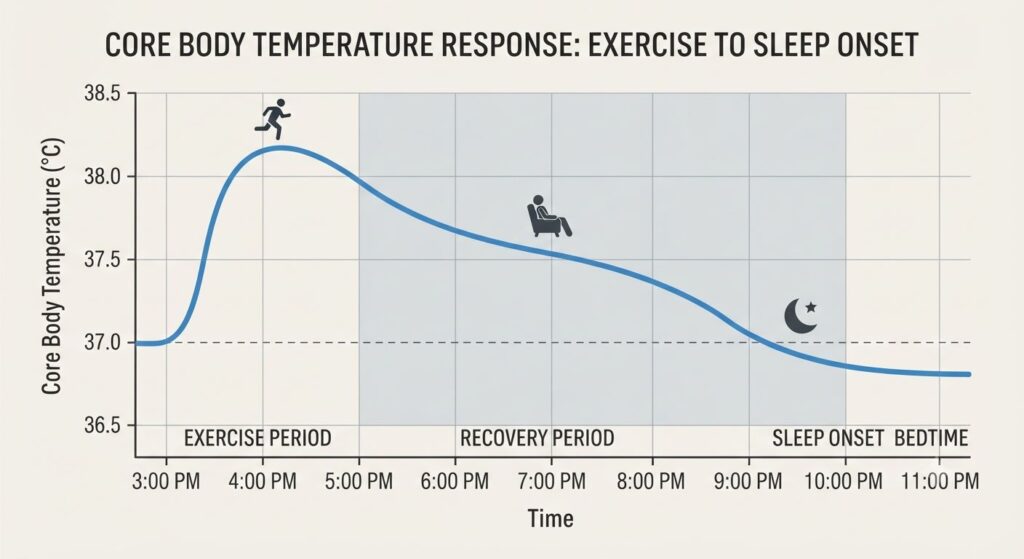
If bedtime arrives before that cooling process is complete, falling asleep may become more difficult. This is one reason why some people benefit from finishing vigorous exercise earlier in the evening rather than immediately before bed.
Stress hormones temporarily increase
Exercise naturally increases hormones such as adrenaline and cortisol to help support physical performance. These hormones are not harmful in this context. They are normal and necessary responses that allow your body to meet increased physical demands.
After exercise, hormone levels gradually return toward baseline.
For most people, this happens without affecting sleep. However, particularly intense workouts or sessions performed close to bedtime may delay this recovery enough to keep some individuals feeling mentally alert even after their muscles become tired.
Evidence Strength
Strong evidence supports the following:
- Moderate regular exercise generally improves long-term sleep quality.
- Vigorous exercise can temporarily increase physiological alertness immediately afterward.
- Elevated core body temperature and delayed nervous system recovery may postpone sleep onset in some individuals.
- Responses vary considerably between individuals, making exercise timing highly personal.
Common Reasons You Can’t Sleep After a Workout
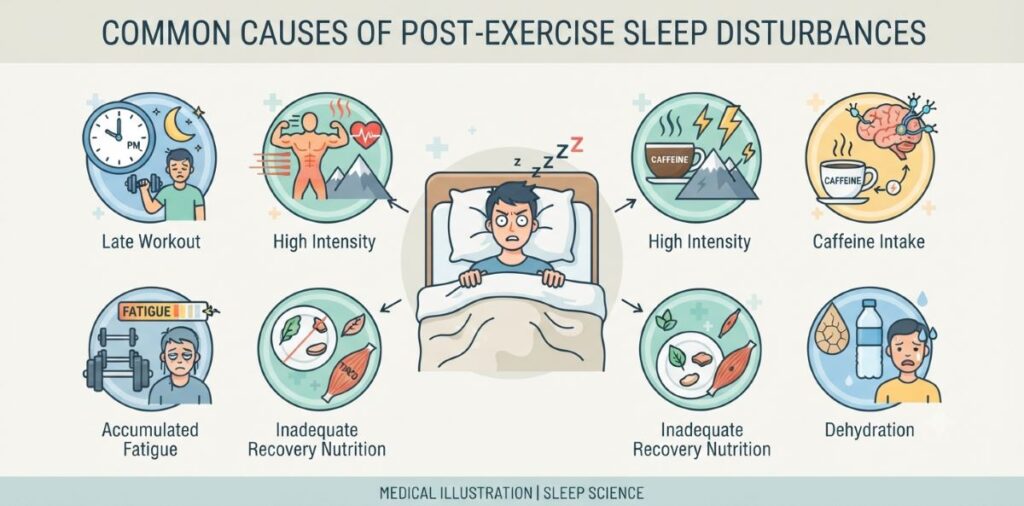
Most people who struggle to fall asleep after exercise are not experiencing a single problem. Instead, several small recovery factors often combine to keep the body in a more alert state than expected. The goal isn’t to find one perfect explanation. It’s to recognize which factors most closely match your own pattern.
You exercised too close to bedtime
The closer an intense workout is to bedtime, the less time your body has to transition into recovery. For some people, this isn’t a problem. They can finish a workout, shower, and fall asleep with little difficulty. Others are more sensitive to the temporary increases in heart rate, body temperature, and nervous system activity that occur after exercise.
Rather than asking whether evening workouts are “good” or “bad,” ask whether your body has enough time to recover before you expect it to sleep. If you consistently notice difficulty falling asleep after late workouts but not after earlier sessions, you’ve identified a useful pattern rather than a universal rule.
Your workout was more intense than usual
Intensity matters just as much as timing. A relaxed walk after dinner creates a very different recovery response than heavy squats, sprint intervals, or a demanding sports practice.
Higher-intensity workouts generally:
- Increase heart rate for longer
- Raise body temperature more
- Produce greater nervous system activation
- Require more recovery afterward
That doesn’t mean intense exercise should be avoided. It simply means your recovery demands increase alongside training intensity.
Pre-workout supplements or caffeine
Many people blame the workout itself when the real cause is what they consumed beforehand. Caffeine can remain in the body for several hours. Depending on the individual, its stimulating effects may still be present at bedtime, especially if a pre-workout supplement, energy drink, or large coffee was consumed in the afternoon or evening.
If difficulty sleeping consistently follows workouts that include stimulants but not workouts without them, that pattern deserves attention.
You didn’t eat enough afterward
Exercise uses stored energy.
If recovery nutrition is delayed or insufficient, your body continues working to restore energy balance long after the workout ends. Inadequate carbohydrate intake may slow glycogen replenishment, while insufficient protein can delay muscle repair. Although one missed meal is unlikely to cause insomnia by itself, consistently under-fueling recovery may contribute to feeling physically exhausted while remaining restless.
Recovery nutrition isn’t simply about supporting muscles; it also supports the transition back toward normal physiological function. Post-workout carbohydrates
Dehydration
Even mild dehydration can leave some people feeling uncomfortable after exercise. Fluid losses affect circulation, heart rate, and temperature regulation, all of which influence recovery. This doesn’t mean everyone needs excessive amounts of water after every workout. Rather, replacing fluids gradually based on sweat losses helps your body complete the recovery process more efficiently.
Accumulated training fatigue
Sometimes the problem isn’t today’s workout.
It’s the previous week. Or the previous month.
When training volume, intensity, work stress, poor sleep, and everyday responsibilities continue building without enough recovery, your body may remain in a prolonged state of physiological stress. In these situations, difficulty sleeping becomes one signal among several rather than an isolated issue.
You might also notice:
- Feeling unusually tired during the day
- Declining workout performance
- Reduced motivation to train
- Longer recovery between sessions
- Persistent muscle soreness
- Feeling “wired but tired”
Recognizing this broader pattern is often more useful than focusing on a single night of poor sleep.
Anxiety or mental overstimulation
Exercise doesn’t only challenge the body. For some people, it also creates mental stimulation. Competitive training, tracking performance metrics, replaying a difficult session, or simply feeling energized after exercise may make it harder for the brain to shift into a quieter state. This doesn’t mean exercise causes anxiety. It means the transition from high engagement to restful sleep may take longer for certain individuals.
Comparison Table: Common Causes of Difficulty Sleeping After Exercise
| Possible Cause | Typical Pattern | Usually Temporary? | May Need Further Attention? |
| Late-evening workout | Trouble falling asleep after night sessions | Yes | If persistent despite schedule adjustments |
| High-intensity exercise | Increased alertness after demanding workouts | Yes | If every workout disrupts sleep |
| Pre-workout or caffeine | Difficulty sleeping on days stimulants are used | Often | If stimulant use is excessive or poorly timed |
| Inadequate recovery meal | Restlessness after longer or harder sessions | Usually | If under-fueling becomes habitual |
| Dehydration | Feeling hot, thirsty, or restless at bedtime | Usually | If accompanied by repeated recovery problems |
| Accumulated training fatigue | Poor sleep alongside declining performance and persistent fatigue | No | Yes |
| Mental overstimulation | Physically tired but mentally active | Often | If anxiety or stress becomes persistent |
Recovery Insight
One restless night rarely tells the whole story. The most useful recovery clues come from patterns that repeat—not isolated experiences.
Does Working Out at Night Cause Insomnia?
This is one of the most common questions people ask after experiencing post-workout sleeplessness. The answer is more nuanced than a simple yes or no.
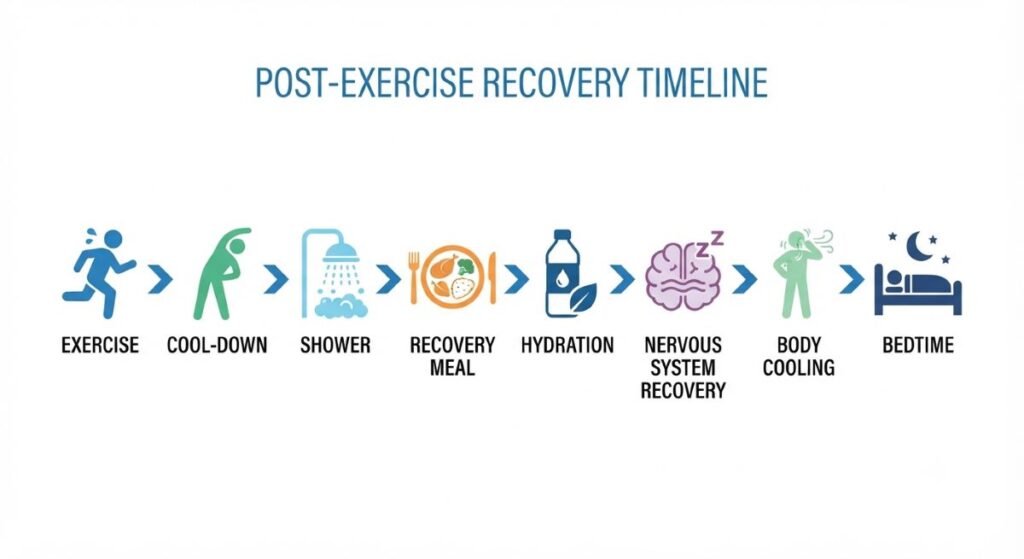
What research says
Research over the past decade has challenged the long-held belief that everyone should avoid exercising at night. For many healthy adults, moderate evening exercise has little effect on sleep quality and may even improve it. The picture changes when workouts are very intense or finish shortly before bedtime. In those situations, some individuals experience delayed sleep onset because their bodies are still completing the recovery process.
The key point is that exercise timing interacts with exercise intensity, fitness level, and individual biology.
Why do some people sleep well after evening exercise
People often adapt to consistent routines. Someone who has exercised after work for years may experience little disruption because their body has become accustomed to that schedule. Regular exercisers also tend to recover more efficiently than beginners, allowing heart rate, body temperature, and nervous system activity to normalize more quickly.
Why others struggle
Others remain more sensitive to evening exercise. Possible reasons include the following:
- Higher workout intensity
- Greater sensitivity to caffeine
- Later workout finish times
- Slower body cooling
- Existing sleep difficulties
- Higher daily stress levels
- Insufficient recovery habits
These differences explain why advice that works perfectly for one person may not work for another.
Individual differences matter more than universal rules
Instead of asking,
“Should everyone avoid exercising at night?”
A more useful question is,
“How does my body respond to evening exercise over time?”
Recovery decisions are strongest when they are based on consistent patterns rather than assumptions.
Evidence Strength
Moderate to strong evidence suggests:
- Regular physical activity generally improves long-term sleep quality.
- Moderate evening exercise is unlikely to harm sleep for most healthy adults.
- Very vigorous exercise performed close to bedtime may delay sleep onset in some individuals.
- Individual responses vary considerably, so personalized observation is more valuable than rigid timing rules.
When Poor Sleep May Be a Sign of Inadequate Recovery
Most nights of post-workout sleeplessness are temporary. A particularly demanding training session, a late finish, or an afternoon pre-workout supplement may be enough to delay sleep without indicating a larger problem. The picture changes when difficulty sleeping becomes part of a repeating pattern.
If poor sleep continues alongside declining performance, persistent fatigue, or increasing soreness, your body may be telling you that recovery is no longer keeping pace with training. This doesn’t automatically mean you’re overtrained. In many cases, it simply means your current recovery strategy needs to match your current training demands.
Normal recovery vs. recovery overload
Every workout creates stress.
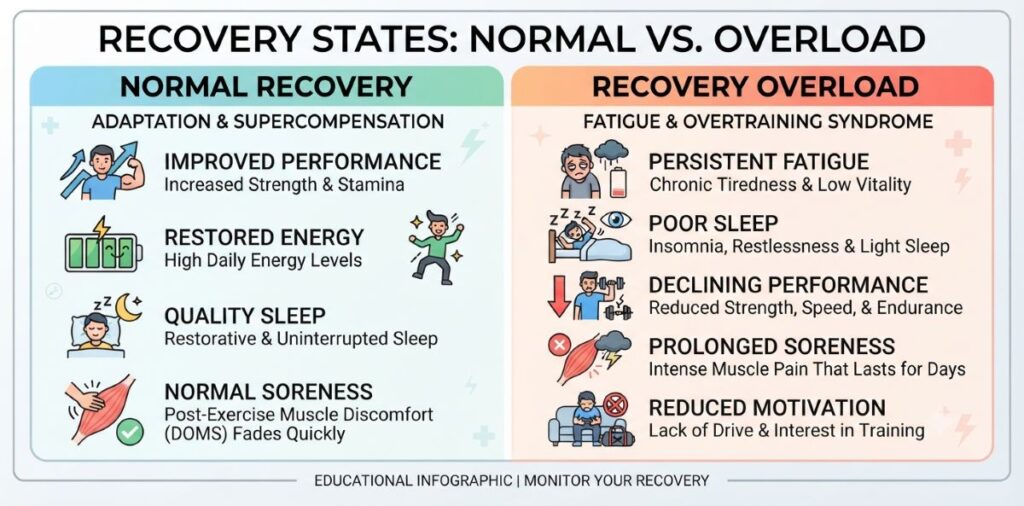
Recovery is the process of adapting to that stress. When recovery is sufficient, your body gradually becomes stronger, fitter, or more resilient. Temporary fatigue resolves, performance stabilizes, and sleep generally returns to normal. Recovery overload occurs when training stress repeatedly exceeds your ability to recover. This can happen because of exercise volume, exercise intensity, inadequate sleep, poor nutrition, illness, work stress, or a combination of factors.
Sleep often reflects this imbalance before performance does.
Signs your body may need more recovery
One difficult night after a workout usually isn’t concerning. A broader pattern deserves attention. You may benefit from adjusting your recovery plan if you notice several of the following:
- Difficulty falling asleep after many workouts
- Waking frequently during the night
- Feeling unusually tired despite spending enough time in bed
- Declining workout performance
- Persistent muscle soreness
- Reduced motivation to exercise
- Elevated resting heart rate over several days
- Feeling mentally drained or unusually irritable
None of these signs confirm overtraining on their own, but together they suggest it’s worth reassessing your overall recovery.
Comparison Table: Normal Recovery vs. Possible Recovery Problem
| Normal Recovery | Possible Recovery Problem |
| Occasional poor sleep after a hard workout | Difficulty sleeping after many workouts |
| Temporary muscle soreness | Persistent soreness that doesn’t improve |
| Energy returns within a day or two | Ongoing fatigue despite rest |
| Performance remains stable or improves | Performance gradually declines |
| Sleep improves after recovery | Sleep continues worsening over time |
| Motivation remains consistent | Motivation decreases noticeably |
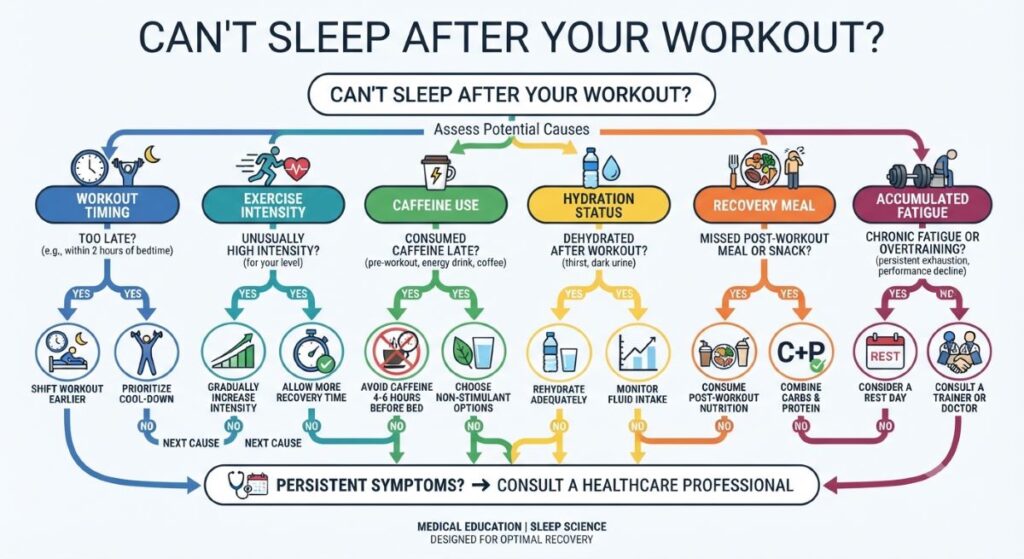
Decision Framework: Why Can’t I Sleep After a Workout?
Rather than searching for a single cause, work through these questions in order.
Step 1: Was today’s workout unusually intense?
- Yes: Your nervous system, heart rate, and body temperature may simply need more time to settle.
- No: Move to the next question.
Step 2: Did you finish exercising within one to two hours of bedtime?
- Yes: Your recovery process may still be underway when you’re trying to sleep.
- No: Continue.
Step 3: Did you consume caffeine or a pre-workout supplement?
- Yes: Stimulants may be contributing more than the workout itself.
- No: Continue.
Step 4: Did you eat and rehydrate after exercise?
- No: Incomplete recovery nutrition or dehydration may be delaying recovery.
- Yes: Continue.
Step 5: Has this happened repeatedly over the past few weeks?
- No: An occasional restless night is usually a normal response to training.
- Yes: Consider your overall recovery, weekly training load, life stress, and sleep habits rather than focusing only on today’s workout.
Step 6: Are other warning signs present?
Examples include:
- Persistent daytime fatigue
- Falling athletic performance
- Frequent illness
- Ongoing insomnia
- Significant mood changes
If several of these occur together, it is reasonable to reduce training temporarily and discuss persistent symptoms with a qualified healthcare professional.
Recovery Insight
Instead of asking, “How do I fall asleep tonight?” ask, “What is my body still recovering from?” That question often leads to better long-term decisions.
When Should You Seek Medical Advice?
Occasional difficulty sleeping after exercise is common and usually improves without medical treatment. However, it is appropriate to seek professional advice if:
- Sleep problems continue for several weeks.
- Insomnia occurs regardless of whether you exercise.
- Poor sleep significantly affects work, school, or daily activities.
- You experience loud snoring, pauses in breathing during sleep, or excessive daytime sleepiness.
- You have chest pain, dizziness, fainting, or persistent palpitations during or after exercise.
- You suspect another health condition or medication may be affecting your sleep.
Exercise-related sleep problems are often manageable, but persistent insomnia deserves proper evaluation rather than repeated self-treatment.
Evidence Strength
Strong clinical evidence supports evaluation of persistent sleep disturbances, especially when they affect daytime function, continue despite good sleep habits, or occur alongside other concerning symptoms.
How to Support Better Sleep After a Workout
There is no single strategy that works for everyone. Instead, think about supporting the recovery process so your body can naturally transition toward sleep.
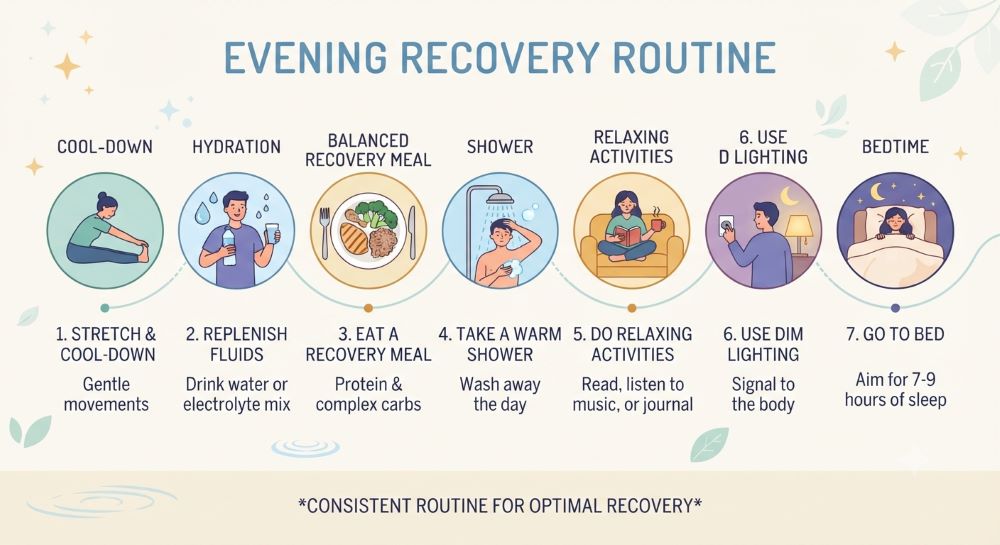
Adjust workout timing when possible
If late-evening workouts consistently delay your sleep, consider moving higher-intensity sessions earlier in the day when your schedule allows. If evening is your only option, remember that exercising later is often healthier than not exercising at all. The goal is to find the timing that works best for your own recovery.
Allow time for cooling down
Finish demanding workouts with a gradual cool-down rather than stopping abruptly. This gives your heart rate, breathing, and circulation time to return toward resting levels.
Eat an appropriate recovery meal
A balanced post-workout meal containing protein and carbohydrates supports muscle repair and energy restoration. If your workout ends close to bedtime, choose a meal that is satisfying without being excessively large or heavy.
Rehydrate gradually
Replace fluids lost through sweat over the hours following exercise. Both dehydration and excessive fluid intake immediately before bed may interfere with comfortable sleep.
Be mindful of stimulant timing
If you regularly use caffeinated pre-workout products, compare nights when you use them with nights when you don’t. Patterns are often more informative than assumptions.
Monitor your overall training load
Recovery depends on everything that happens between workouts, not just the workouts themselves. Sleep, nutrition, hydration, work stress, travel, and illness all influence your ability to recover. When several stressors occur at once, your recovery capacity may temporarily decrease even if your training plan hasn’t changed.
Recovery Reminder
One poor night’s sleep after a challenging workout does not usually mean you’ve trained incorrectly. Instead of reacting to a single experience, look for patterns across several weeks. Consistent observations are far more useful than isolated events when making decisions about training and recovery.
If you’ve been wondering why you can’t sleep after a workout, remember that the answer often lies in recovery rather than sleep alone. Exercise temporarily increases alertness, raises body temperature, elevates heart rate, and activates the nervous system. These changes are normal, but they don’t resolve instantly when your workout ends.
Most occasional episodes improve as recovery catches up. When sleep problems become frequent, however, it’s worth looking beyond bedtime and considering your training intensity, exercise timing, nutrition, hydration, stimulant use, and overall recovery load. The goal isn’t simply to fall asleep faster tonight. It’s to build recovery habits that allow both your training and your sleep to support one another over time.
Clinical Takeaway
Most people who struggle to sleep after exercise are experiencing a temporary recovery response rather than a harmful effect of exercise itself. By paying attention to workout timing, exercise intensity, recovery nutrition, hydration, and stimulant use, many cases can be improved without giving up regular physical activity. Persistent or worsening sleep problems should be evaluated by a qualified healthcare professional.
Frequently Asked Questions
Why can’t I sleep after a workout even though I’m exhausted?
Feeling exhausted after exercise doesn’t necessarily mean your body is ready for sleep. Your muscles may be fatigued while your nervous system, heart rate, body temperature, and stress hormones are still returning to their resting levels.
Is it normal to have trouble sleeping after exercise?
Yes. Occasional difficulty sleeping after an intense or late-evening workout is common. Most people experience it from time to time, and it usually resolves as the body completes its recovery.
Does lifting weights make it harder to sleep?
Not necessarily. Strength training generally supports better long-term sleep. However, very heavy resistance training performed close to bedtime may temporarily increase nervous system activity, making it harder for some people to fall asleep immediately afterward.
Is cardio more likely than weight training to keep you awake?
Neither type of exercise consistently causes more sleep problems than the other. The intensity, duration, timing, and your individual response usually matter more than whether you perform cardio or resistance training.
How long should I wait before going to bed after a workout?
There isn’t a single time that works for everyone. Many people benefit from allowing enough time for their heart rate and body temperature to move closer to resting levels before trying to sleep.
Can pre-workout supplements cause insomnia?
Yes. Many pre-workout supplements contain caffeine or other stimulants that can remain active for several hours. If you regularly struggle to sleep after using a pre-workout product, compare your sleep on days when you train without it. The pattern may provide valuable insight.
Can overtraining affect sleep quality?
Yes. Persistent sleep disturbances can occur when training stress consistently exceeds your ability to recover. However, poor sleep alone does not confirm overtraining. Consider the broader picture, including fatigue, declining performance, persistent soreness, mood changes, and overall training load.
Why can’t I sleep after a workout if I exercise every day?
If you’re asking why you can’t sleep after a workout despite exercising regularly, the answer may not be the workout itself. Your overall recovery capacity could be affected by accumulated training stress, inadequate nutrition, dehydration, stimulant use, or insufficient sleep between workouts. Looking at your weekly recovery patterns is often more helpful than focusing on a single exercise session. Recovery strategies after exercise
Should I stop exercising at night?
Not necessarily. If evening exercise fits your schedule and you generally sleep well, there’s usually no reason to stop. However, if you repeatedly notice that late, high-intensity workouts delay your sleep, consider moving those sessions earlier when possible or adjusting their intensity while monitoring how your sleep responds.
When should I see a doctor?
You should seek medical advice if:
Difficulty sleeping persists for several weeks.
Sleep problems occur even when you haven’t exercised.
Poor sleep significantly affects your daily life.
You experience chest pain, fainting, or persistent heart palpitations during or after exercise.
You have symptoms such as loud snoring, pauses in breathing during sleep, or excessive daytime sleepiness.
You suspect another medical condition may be contributing to your sleep difficulties.
Medical Disclaimer
This article is intended for educational and informational purposes only. It is not a substitute for professional medical advice, diagnosis, or treatment. Exercise-related sleep changes vary between individuals, and persistent insomnia or concerning symptoms should always be evaluated by a qualified healthcare professional. Never ignore or delay seeking medical advice because of information you have read online.
Evidence & Scientific References
1. Stutz J, Eiholzer R, Spengler CM. (2019)
Effects of Evening Exercise on Sleep in Healthy Participants: A Systematic Review and Meta-Analysis.
Journal: Sports Medicine.
DOI 10.1007/s40279-018-1015-0
Official Publisher: Springer
PubMed
2. Frimpong E, Mograss M, Zvionow T, Dang-Vu TT. (2021)
The Effects of Evening High-Intensity Exercise on Sleep in Healthy Adults: A Systematic Review and Meta-Analysis.
Journal: Sleep Medicine Reviews.
DOI: 10.1016/j.smrv.2021.101535
Official Publisher: Elsevier
PubMed
3. Yue T, Liu X, Gao Q, et al. (2022)
Different Intensities of Evening Exercise on Sleep in Healthy Adults: A Systematic Review and Network Meta-Analysis.
Journal: Nature and Science of Sleep.
DOI: 10.2147/NSS.S388863
Official Publisher: Dove Medical Press
PubMed / PMC
4. Riedel A, Benz F, et al. (2024)
The Effect of Physical Exercise Interventions on Insomnia: A Systematic Review and Meta-Analysis.
Journal: Sleep Medicine Reviews.
DOI: 10.1016/j.smrv.2024.101948
Official Publisher: Elsevier
5. Tian C, Wei Y, Xu M, et al. (2024)
The Effects of Exercise on Insomnia Disorders: An Umbrella Review and Network Meta-Analysis.
Journal: Sleep.
DOI: 10.1016/j.sleep.2024.02.002
Official Publisher: Elsevier
Professional Organizations
American Academy of Sleep Medicine (AASM):
Official Website: https://aasm.org/
Centers for Disease Control and Prevention (CDC)
Official Website: https://www.cdc.gov/sleep
National Heart, Lung, and Blood Institute (NHLBI)
Organization
National Heart, Lung, and Blood Institute
Official Website: Websitehttps://www.nhlbi.nih.gov/health/sleep

I’m Mr. Baig, founder of Recover Better Lab. I create evidence-based fitness recovery content to help beginners recover smarter and build sustainable healthy habits.
Mission: My mission is to provide trustworthy, research-backed recovery and fitness content that helps people optimize their health, performance, and overall well-being.