
Estimated Reading Time: 10–12 minutes
Last Reviewed: July 2026
Quick Answer
Is the anabolic window real?
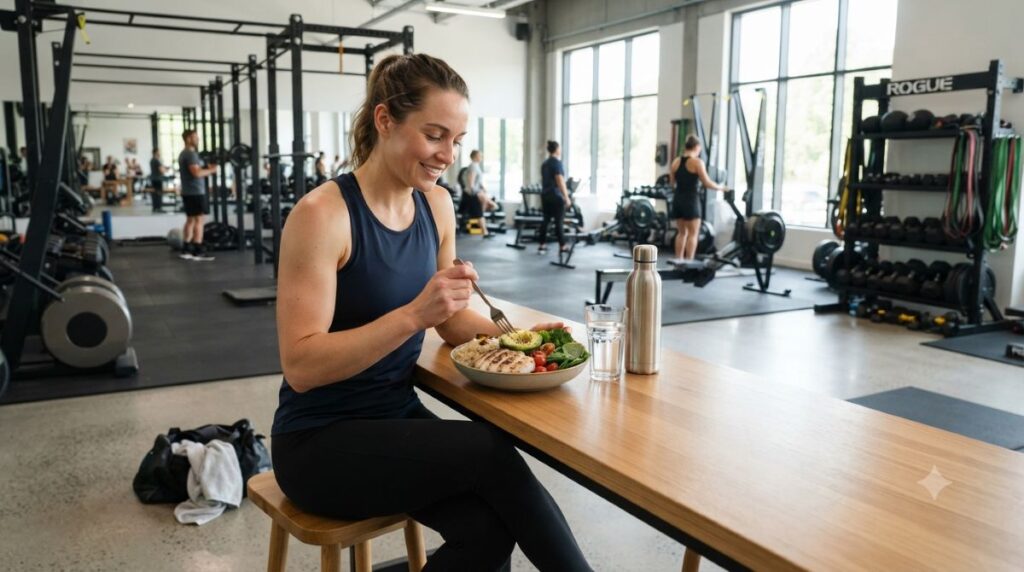
Yes. The anabolic window is real, but not in the way it’s often described. After exercise, your muscles become more responsive to nutrients that support muscle protein synthesis and glycogen replenishment. However, current evidence shows this nutrient timing window is much wider than the traditional 30-minute rule. For most healthy adults, eating a balanced meal containing protein and carbohydrates within a few hours after exercise is enough. Immediate eating becomes more important after fasted workouts, prolonged endurance exercise, or multiple training sessions in one day.
Key Takeaways
- The anabolic window exists but is not limited to 30 minutes.
- Daily protein intake usually matters more than eating immediately after exercise.
- Meal timing becomes more important after fasted or prolonged workouts.
- Recovery depends on your overall nutrition, training, sleep, and hydration, not a stopwatch.
Table of Contents
Is the Anabolic Window Real?
You finish your workout, glance at the clock, and suddenly wonder if you need to eat right away. Maybe you’ve heard that waiting too long means you’ve “missed your anabolic window” and lost your chance to build muscle. For many people, that’s not realistic. You might be driving home from the gym, heading back to work, or simply not feeling hungry immediately after exercise. This is where much of the confusion begins. The real question isn’t whether your muscles can recover—it’s how much nutrient timing actually influences muscle protein synthesis and recovery after resistance training. Learn whether you should eat before or after a workout.
The idea of a strict 30-minute deadline has been repeated for years, but modern sports nutrition research paints a more balanced picture. Recovery is important, but it isn’t controlled by a countdown timer. The real question isn’t whether you should eat after exercise. It’s how much timing matters for your type of workout and your overall nutrition. Understanding that difference can help you make better recovery decisions without unnecessary stress.
What Is the Anabolic Window?
The anabolic window is the period after exercise when your body is especially responsive to nutrients that support muscle repair and recovery. After a workout, several processes begin at the same time:
- Muscle protein synthesis increases damaged muscle tissue.
- Glycogen stores are beginning to replenish.
- Your muscles become more sensitive to nutrients, particularly protein and carbohydrates.
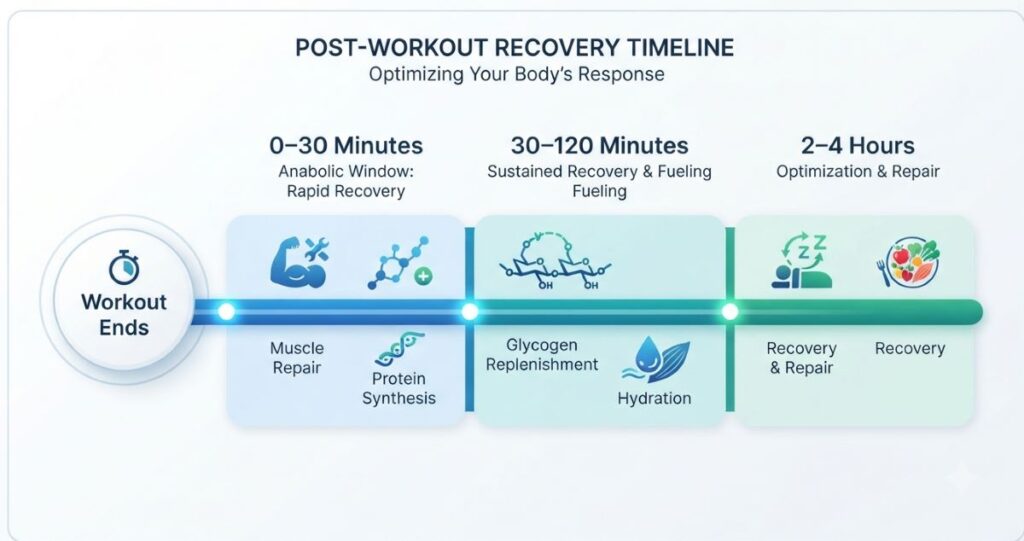
These changes are real, which is why post-workout nutrition remains an important part of recovery. The misconception is that this opportunity disappears after 30 minutes. Current evidence suggests that muscle protein synthesis remains elevated for several hours after resistance exercise, meaning the body’s recovery response lasts much longer than once believed for most healthy adults.
Is the Anabolic Window Real or Just a Fitness Myth?
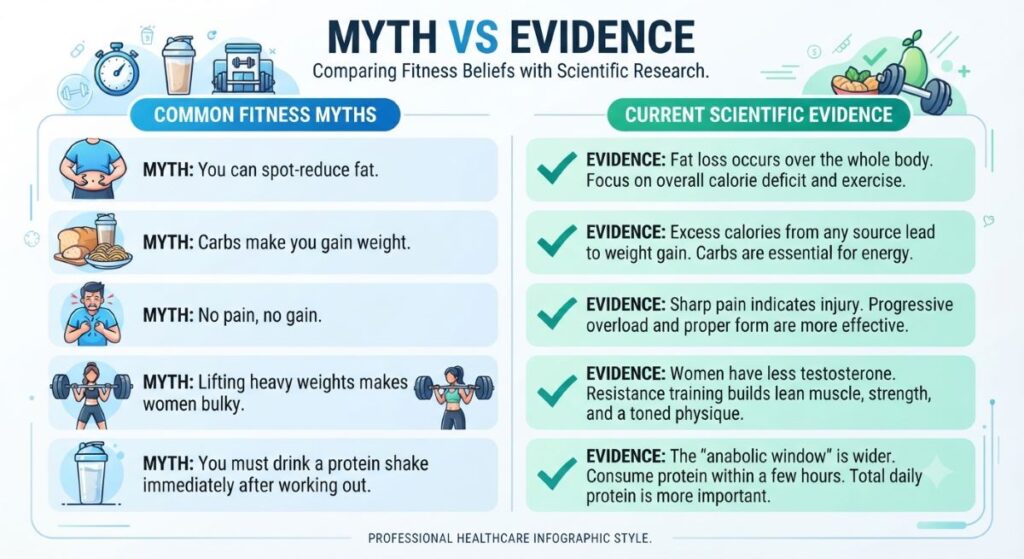
The answer is both yes and no.
The anabolic window is real because your muscles respond to nutrients after exercise. However, the popular belief that you have only 30 minutes to eat or lose your gains is an oversimplification that isn’t supported by most people. Research now suggests that recovery nutrition should be viewed as a window of opportunity rather than a narrow deadline. How important immediate eating is depends on factors such as the following:
- What did you eat before your workout?
- The type and duration of your exercise.
- Whether you trained in a fasted state.
- When will your next workout be?
For someone who ate a balanced meal one to two hours before lifting weights, rushing for a protein shake immediately afterward is usually far less important than meeting their overall daily protein and energy needs.
Recovery Insight
Think of the anabolic window as a sliding window, not a closing door. Recovery doesn’t suddenly stop because 30 minutes have passed. For most people, consistent nutrition throughout the day has a greater impact than perfect meal timing.
Is the 30-Minute Anabolic Window Real?
The idea that you have exactly 30 minutes to eat after a workout has become one of the most persistent beliefs in fitness. For years, athletes and recreational exercisers alike were told that missing this short window would reduce muscle growth and limit recovery. As a result, many people rushed to drink protein shakes before leaving the gym.
Current evidence tells a more nuanced story.
Exercise does make your muscles more responsive to nutrients, but that response doesn’t disappear after half an hour. Instead, the body’s recovery processes continue for several hours, and the ideal timing of your post-workout meal depends on your training, previous meals, and overall daily nutrition. In other words, the anabolic window is real, but it is much wider than once believed.
Why Did the 30-Minute Rule Become Popular?
The 30-minute recommendation originated from early sports nutrition studies showing that consuming nutrients after exercise could support glycogen replenishment and stimulate muscle protein synthesis.
While these findings were important, the message gradually became oversimplified. Instead of understanding that post-work-out nutrition supports recovery, many people came to believe they had only 30 minutes before the opportunity disappeared. Modern research has challenged this interpretation. Scientists now recognize that recovery is influenced by multiple factors, including your pre-workout meal, total daily protein intake, exercise intensity, and how soon you’ll train again.
What Does Current Research Say?
Rather than focusing on a strict deadline, systematic reviews and position stands from leading sports nutrition organizations recommend looking at your overall daily nutrition instead of a narrow post-workout window.
If you consumed a balanced meal containing protein and carbohydrates within a few hours before your workout, your body is likely still digesting and absorbing those nutrients afterward. In this situation, eating immediately is usually less important than ensuring you meet your daily protein and energy needs.
However, delaying food for an extended period may not be ideal in every situation, especially if recovery time between workouts is limited. Immediate post-workout nutrition becomes more important after fasted training, prolonged endurance exercise, or multiple training sessions in one day
Reference: International Society of Sports Nutrition Position Stand: Nutrient Timing
https://jissn.biomedcentral.com/articles/10.1186/1550-2783-10-5
Comparison Table: Traditional Advice vs. Current Evidence
| Traditional Advice | Current Scientific Understanding |
| Eat within 30 minutes after every workout. | The recovery window is generally much longer for most people. |
| Missing the window reduces muscle growth. | Overall daily nutrition has a greater influence on long-term adaptation. |
| Everyone needs an immediate protein shake. | Whole foods or supplements can both support recovery when total intake is adequate. |
| The same rule applies to everyone. | Recovery nutrition should be adjusted based on workout type, goals, and individual circumstances. |
Recovery Insight
Don’t let the clock distract you from the bigger picture. A nutritious diet, adequate protein intake, quality sleep, and consistent training have a much greater impact on recovery than eating at exactly the right minute.
When Does Meal Timing Actually Matter?
Although the anabolic window is wider than many people believe, meal timing still matters in certain situations. The key is understanding when immediate nutrition offers meaningful benefits and when a more flexible approach is perfectly reasonable.
Reference: Schoenfeld BJ, Aragon AA.
Nutrient Timing Revisited: Is There a Post-Exercise Anabolic Window?
https://jissn.biomedcentral.com/articles/10.1186/1550-2783-10-5
After a Fasted Workout
If you exercise before breakfast or several hours after your last meal, your body has fewer readily available nutrients. Eating a meal that contains protein and carbohydrates relatively soon after finishing can help support muscle protein synthesis and begin replenishing energy stores.
Recovery Priority: High
After Prolonged Endurance Exercise
Long-distance running, cycling, swimming, or other endurance activities can significantly reduce muscle glycogen stores. Replacing carbohydrates soon after exercise helps restore these energy reserves, particularly if another training session is planned within the next 24 hours.
Recovery Priority: High
When Training More Than Once a Day
Athletes completing two or more training sessions in a single day have less time to recover. In these cases, earlier intake of protein and carbohydrates can improve glycogen restoration and prepare the body for the next workout.
Recovery Priority: High
After Resistance Training Following a Recent Meal
Suppose you ate lunch for one to two hours before lifting weights. Your body is still digesting and absorbing nutrients from that meal while you train. As a result, there’s usually no need to rush for a protein shake the moment your workout ends. A balanced meal within the next couple of hours is generally sufficient for most healthy adults.
Recovery Priority: Moderate
After Light or Recreational Exercise
If your workout was relatively short or low in intensity, recovery demands are lower. Eating your next planned meal is usually enough, provided your overall diet contains adequate protein, carbohydrates, and calories.
Recovery Priority: Lower
Recovery Priority Comparison
| Situation | Should You Eat Soon? | Why? |
| Fasted morning workout | ✔ Yes | Supports muscle repair and recovery. |
| Long endurance session | ✔ Yes | Help replenish depleted glycogen stores. |
| Two workouts in one day | ✔ Yes | Reduces recovery time between sessions. |
| Strength Workout After a recent meal | Usually, but not urgently | Nutrients from the earlier meal are still available. |
| Light recreational exercise | Flexible | Recovery demands are generally lower. |
The takeaway isn’t that everyone should ignore meal timing. Instead, the importance of the anabolic window depends on your training context rather than a universal 30-minute deadline.
Which Matters More: Meal Timing or Daily Nutrition?
One of the biggest misconceptions in sports nutrition is that meal timing can compensate for poor overall nutrition.
Your body responds to the nutrition you provide throughout the entire day, not just during the hours after exercise. If your daily diet consistently falls short of protein, calories, or other essential nutrients, eating a protein shake within 30 minutes of every workout is unlikely to produce the results you’re hoping for. For most healthy adults, the following factors have a greater influence on muscle recovery and adaptation than perfectly timed meals:
- Total daily protein intake
- Overall calorie intake
- Consistent resistance or endurance training
- Adequate sleep
- Hydration
- Recovery between training sessions
Meal timing still plays a role, but it works alongside these habits rather than replacing them.
Daily Protein Intake Matters Most
Protein provides the amino acids your body needs to repair and build muscle tissue. Research suggests that consuming enough high-quality protein throughout the day—and distributing it across several meals—supports muscle protein synthesis more effectively than relying on a single perfectly timed post-workout meal. For most healthy adults, total daily protein intake remains the most important nutritional factor for recovery and muscle adaptation.
Reference: Tipton KD, Rasmussen BB, Miller SL, et al.
Timing of Amino Acid-Carbohydrate Ingestion Alters Anabolic Response of Muscle to Resistance Exercise
https://journals.physiology.org/doi/full/10.1152/ajpendo.2001.281.2.E197
Recovery Depends on the Whole Picture
Think of recovery as a puzzle.
Post-workout nutrition is one important piece, but it cannot compensate for missing sleep, inadequate calories, dehydration, or inconsistent training. Improving one habit while neglecting others rarely leads to the best results.
Reference: Morton RW, et al.
A Systematic Review, Meta-analysis, and Meta-regression of Protein Supplementation on Resistance Training-Induced Gains in Muscle Mass and Strength. https://bjsm.bmj.com/content/52/6/376
Comparison Table: What Influences Recovery Most?
| Recovery Factor | Importance for Most People |
| Total daily protein intake | ⭐⭐⭐⭐⭐ Very High |
| Adequate calorie intake | ⭐⭐⭐⭐⭐ Very High |
| Quality sleep | ⭐⭐⭐⭐⭐ Very High |
| Progressive training | ⭐⭐⭐⭐⭐ Very High |
| Hydration | ⭐⭐⭐⭐ High |
| Meal timing | ⭐⭐⭐ Moderate |
| Eating within exactly 30 minutes | ⭐ Low |
Recovery Insight
Don’t let perfect timing distract you from consistent habits. Meeting your daily protein and energy needs is usually more important than eating at the same time after every workout.
What Should You Eat After a Workout?
The best post-workout meal doesn’t have to be complicated. For most people, combining protein, carbohydrates, and fluids provides the nutrients needed to support recovery.
Protein supplies essential amino acids that help repair and build muscle tissue after exercise. Good options include:
- Eggs
- Greek yogurt
- Chicken
- Fish
- Lean beef
- Cottage cheese
- Tofu
- Beans and lentils
- Milk
- Protein shakes (when convenient)
If you’d like to compare supplements with regular meals, read our guide on protein shakes versus whole foods after a workout.
Carbohydrates help restore glycogen, the body’s stored form of energy. After moderate or intense exercise, include carbohydrate-rich foods such as the following:
- Rice
- Potatoes
- Oats
- Whole-grain bread
- Fruit
- Pasta
- Quinoa
The amount you need depends on your workout duration, intensity, and training goals. For a detailed breakdown, see our article on how many carbs you need after a workout.
Sweat loss varies between individuals, but replacing fluids remains an essential part of recovery. Water is sufficient for many workouts, while longer or more intense sessions may require beverages containing electrolytes.
Whole foods and protein supplements can both support recovery. Protein shakes are useful when:
- You need a convenient option.
- You won’t have access to a meal for several hours.
- Meeting your daily protein target is difficult.
Otherwise, a balanced meal provides similar nutritional benefits.
Recovery Reminder
There is no “perfect” post-workout meal. Choose foods you enjoy, can prepare consistently, and that help you meet your daily nutrition goals.
How to Decide Whether You Should Eat Immediately
Instead of asking,
“Have I missed my anabolic window?”
Ask a more useful question:
“How demanding was today’s workout, and when will I eat next?”
That simple shift leads to better recovery decisions.
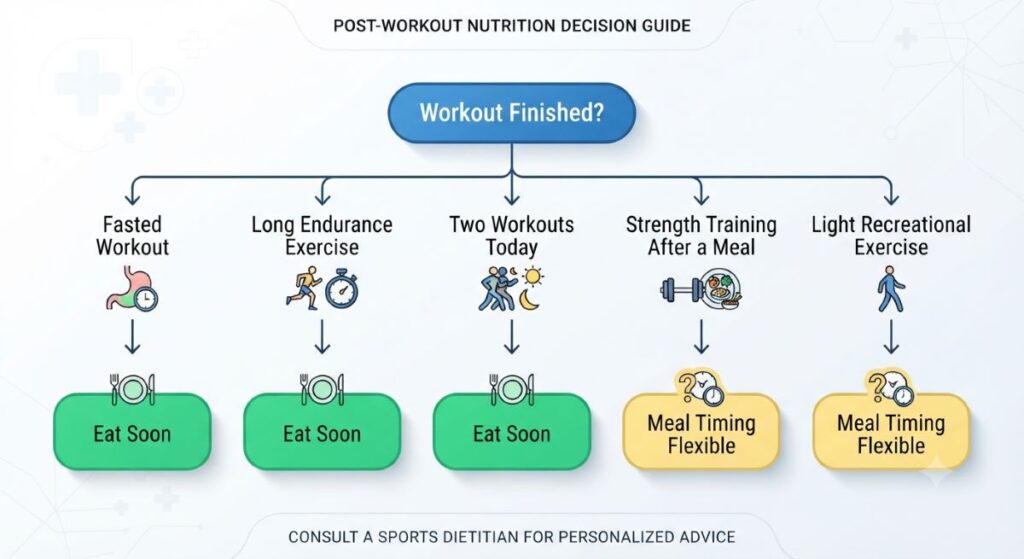
Recovery Decision Guide
| Situation | Eat Soon? | Reason |
| Fasted morning workout | ✔ Yes | Supports muscle repair and energy replenishment. |
| Long endurance session | ✔ Yes | Helps restore glycogen and begin recovery. |
| Two training sessions today | ✔ Yes | Maximizes recovery before the next session. |
| Strength workout after a recent meal | Usually, but not urgently | Nutrients from the previous meal are still available. |
| Light recreational exercise | Flexible | Recovery demands are lower. |
For most people, eating a balanced meal within the next few hours is perfectly reasonable. What matters most is maintaining consistent eating habits that support your training, not racing against an arbitrary deadline.
Recover Better Lab Summary
The anabolic window is real, but it is far more flexible than the traditional 30-minute rule suggests. While timely nutrition can benefit certain situations, such as fasted workouts, endurance events, or multiple daily training sessions, most people will recover well by meeting their daily protein and energy needs and eating a balanced meal within a few hours after exercise. Focus on building sustainable recovery habits rather than worrying about the clock.
Editorial Evidence Summary
| Topic | Strength of Evidence | Summary |
| Total daily protein intake supports muscle growth. | Strong | Consistently supported by systematic reviews, meta-analyses, and sports nutrition guidelines. |
| Muscle protein synthesis increases after exercise. | Strong | Well established in exercise physiology research. |
| The anabolic window is wider than 30 minutes. | Moderate to Strong | Current evidence suggests a flexible recovery period rather than a strict deadline. |
| Immediate post-workout nutrition benefits fasted or multiple daily training sessions. | Moderate | Benefits are greater when recovery time is limited or nutrient availability is low. |
| Everyone must eat within 30 minutes. | Weak | Current evidence does not support this as a universal recommendation. |
Medical Disclaimer
This article is intended for educational purposes only and should not be considered medical or nutritional advice. Individual recovery needs vary depending on age, health status, training level, medical conditions, and personal goals. If you have a medical condition or specific dietary requirements, consult a qualified healthcare professional or registered dietitian before making significant changes to your nutrition plan.
Conclusion
Is the anabolic window real? Yes, but it’s not the narrow 30-minute deadline that many people have been led to believe.
Exercise creates a period when your muscles are more responsive to nutrients that support repair and adaptation. However, this opportunity lasts much longer than many traditional fitness recommendations suggest. For most healthy adults, eating a balanced meal containing protein and carbohydrates within a few hours after exercise is enough to support recovery.
That doesn’t mean meal timing is unimportant. Immediate post-workout nutrition can be beneficial after fasted workouts, prolonged endurance exercise, or when completing multiple training sessions in a single day. In these situations, earlier nutrient intake helps support muscle recovery and replenish energy stores.
For everyone else, the bigger priorities remain the same:
- Eat enough protein throughout the day.
- Meet your overall calorie needs.
- Stay hydrated.
- Prioritize quality sleep.
- Follow a consistent training program.
Rather than worrying about beating a 30-minute countdown, focus on building recovery habits you can maintain over time. Consistency is not perfect timing; it is what supports long-term progress.
Frequently Asked Questions
1. Is the anabolic window only 30 minutes?
No. Current research suggests the anabolic window is much wider than 30 minutes. For most people, eating a balanced meal within a few hours after exercise is sufficient, especially if they ate before training.
2. What happens if I wait two hours to eat after a workout?
For most healthy adults, waiting up to two hours is unlikely to negatively affect recovery if overall daily nutrition is adequate. However, eating sooner may be beneficial after fasted workouts or when another training session is planned later the same day.
3. Do I need a protein shake immediately after lifting weights?
Not necessarily. A protein shake is a convenient option, but it isn’t required. Whole foods that provide high-quality protein can support recovery just as effectively.
4. Does the anabolic window apply to cardio as well as strength training?
Yes, but the priorities differ. After prolonged endurance exercise, replacing carbohydrates becomes particularly important to restore glycogen stores. After resistance training, adequate protein intake plays a larger role in supporting muscle repair.
5. Is total daily protein intake more important than meal timing?
For most people, yes. Research consistently shows that consuming enough protein throughout the day has a greater influence on muscle growth and recovery than eating at an exact time after exercise.
Recover Better Lab Final Takeaway:
The anabolic window isn’t a myth, but neither is it a race against the clock. Think of it as a window of opportunity, not a 30-minute deadline. By understanding when meal timing truly matters and focusing on consistent nutrition, you can make recovery decisions based on evidence rather than outdated fitness myths.
Reference
International Society of Sports Nutrition (ISSN)
American College of Sports Medicine (ACSM)
Academy of Nutrition and Dietetics
Peer-reviewed journal articles (preferably systematic reviews or meta-analyses)

I’m Mr. Baig, founder of Recover Better Lab. I create evidence-based fitness recovery content to help beginners recover smarter and build sustainable healthy habits.
Mission: My mission is to provide trustworthy, research-backed recovery and fitness content that helps people optimize their health, performance, and overall well-being.