

Reading Time: 10 minutes
Last Updated: August 2026
Quick Answer
Signs of workout recovery include improved muscle soreness, normal energy levels, restored performance, good sleep, a stable resting heart rate, normal movement, and feeling mentally ready to exercise. No single sign can confirm full recovery. Looking at several recovery markers together provides a more reliable way to decide whether your body is ready for the next workout.
Introduction
You finished a challenging workout yesterday. Today, you’re asking yourself a simple question: Am I ready to train again?
It sounds like it should have a simple answer. If you’re no longer sore, you might assume you’re fully recovered. If you’re still feeling stiff, you may think another workout would do more harm than good. Recovery isn’t that straightforward.
Your body doesn’t recover all at once. Muscles, energy stores, the nervous system, connective tissues, and even your mental readiness all recover on their own timelines. That’s why one recovery sign, such as muscle soreness, doesn’t always reflect what’s happening throughout your body.
This is where many people become uncertain. They either return to training too soon because they “feel fine,” or they wait longer than necessary because they’re still mildly sore. Both approaches can interfere with consistent progress.
Rather than relying on a single signal, it’s more helpful to look at multiple signs of workout recovery together. When several recovery markers point in the same direction, you can make a more informed decision about whether to train, reduce your workout intensity, or take another recovery day.
In this article, you’ll learn what full recovery means, why soreness is only one piece of the picture, and the science-backed recovery signs that can help you decide whether your body is ready for its next workout.
What You’ll Learn
At the end of this guide, you’ll understand:
- What does full workout recovery mean?
- The difference between recovery and readiness.
- Which recovery signs are supported by scientific evidence.
- Why muscle soreness can be misleading.
- How to use a simple recovery checklist before your next workout.
- When it’s better to train, modify your workout, or take another day to recover.
Why Knowing You’re Fully Recovered Matters
Most workouts don’t make you stronger while you’re doing them. They create a challenge that your body responds to afterward.
During recovery, your muscles repair microscopic damage, your energy stores are replenished, your nervous system regains its capacity to produce force, and your body adapts to the stress it experienced. These adaptations gradually improve strength, endurance, speed, and overall fitness.
If recovery is incomplete, your next workout may be performed with lingering fatigue rather than renewed capacity. Over time, repeatedly training before recovering adequately can reduce workout quality, slow progress, and increase the likelihood of overuse injuries.
That doesn’t mean every workout requires complete recovery. Many training programs intentionally alternate hard and easy sessions or use planned periods of increased training load. The key is to understand whether your current workout matches your body’s level of recovery.
Recovery vs. Readiness: They’re Not the Same Thing
Although these terms are often used interchangeably, they describe different concepts. Recovery is the biological process of repairing and restoring your body after exercise. Readiness is your ability to perform the workout you plan to do today.
| Recovery | Readiness |
| Biological repair | Ability to perform |
| Physiological process | Practical decision |
| Happens continuously | Assessed before training |
You can be:
- Recovering but not yet ready for another high-intensity workout.
- Mostly recovered and ready for a light or moderate session.
- Recovered in one system but not another, such as having normal energy while your muscles or connective tissues are still adapting.
This distinction explains why there isn’t a single recovery marker that works for everyone. Feeling energetic doesn’t always mean your body has finished recovering, and mild muscle soreness doesn’t automatically mean you should skip training.
Instead of asking,
“Am I fully recovered?”
A more practical question is,
“Am I recovered enough for the workout I’m planning today?”
That shift in thinking leads to better training decisions because recovery is always relative to the demands of the next session.
What Can Happen If You Train Too Soon?
Occasionally training before you’ve fully recovered isn’t necessarily harmful. Many well-designed training programs intentionally include periods of accumulated fatigue to stimulate adaptation. The problem arises when insufficient recovery becomes a consistent pattern.
Over time, this may lead to:
- Lower training performance.
- Persistent fatigue that doesn’t improve between sessions.
- Reduced strength, power, or endurance.
- Slow recovery after each workout.
- Increased risk of overuse injuries.
- Decreased motivation to exercise.
- Difficulty maintaining training consistency.
On the other hand, waiting for every sign of fatigue to disappear before exercising again isn’t always the best approach either. Mild soreness or temporary tiredness can often be compatible with productive training, particularly if the next session targets different muscle groups or uses a lower intensity.
The goal isn’t to wait until your body feels perfect. The goal is to recognize whether your body has recovered well enough for the demands of your next workout.
That’s why relying on multiple signs of workout recovery is more useful than focusing on a single indicator. In the next section, we’ll look at what happens inside your body after exercise and why different parts of your body recover at different speeds.
What Happens Inside Your Body During Recovery?
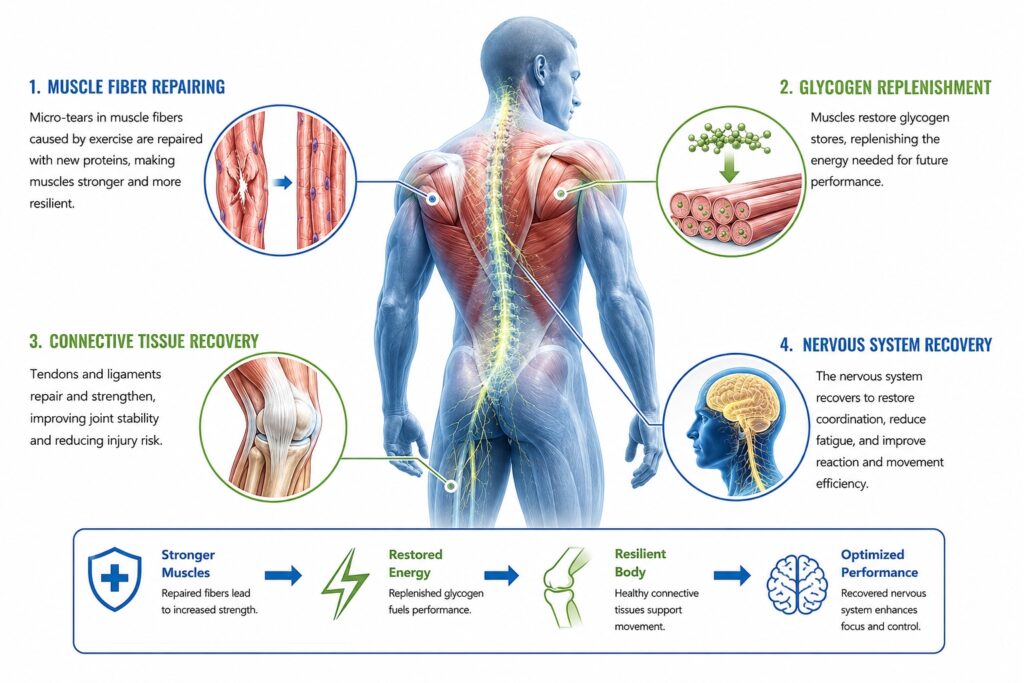
Recovery begins long before your muscles stop feeling sore. The moment you finish exercising, your body starts repairing the stress created by that workout. But recovery isn’t handled by a single system. Several processes happen at the same time, each following its own timeline.
That’s one reason it can be difficult to judge whether you’re truly ready for another workout. One part of your body may have recovered, while another is still adapting. Understanding these processes makes it easier to interpret the signs of workout recovery instead of relying on guesswork.
Muscle Repair and Protein Synthesis
During resistance training and other demanding exercise, muscle fibers experience small amounts of microscopic damage. This isn’t harmful; it’s a normal part of the adaptation process.
After your workout, your body increases muscle protein synthesis, the process of repairing and rebuilding these muscle fibers. Given enough protein, energy, sleep, and recovery time, your muscles become better prepared to handle future training.
This repair process doesn’t stop simply because soreness fades. Muscle adaptation continues even after you begin feeling normal again. That’s why the absence of soreness shouldn’t be interpreted as proof that muscle recovery is complete.
Restoring Energy Stores
Exercise uses glycogen, the stored form of carbohydrate found in your muscles and liver, as a primary source of energy. After your workout, your body gradually replaces these energy stores through nutrition and recovery. How quickly this happens depends on several factors, including:
- The type and intensity of exercise.
- How long have you been doing exercise?
- Your carbohydrate intake.
- Your overall calorie intake.
- The time available before your next workout.
If glycogen stores haven’t recovered adequately, you may notice:
- Lower energy levels.
- Earlier fatigue during exercise.
- Reduced endurance.
- Difficulty maintaining your usual training intensity.
Feeling unusually tired during a routine workout can sometimes reflect incomplete energy restoration rather than poor fitness.
Nervous System Recovery
Recovery isn’t only about muscles. Every movement you perform depends on communication between your brain, spinal cord, and muscles. Intense exercise can temporarily reduce the efficiency of this system, a phenomenon often referred to as neuromuscular fatigue. When your nervous system hasn’t fully recovered, you might notice the following:
- Slower reaction times.
- Reduced coordination.
- Heavier-feeling lifts.
- Less explosive movements.
- A greater effort required for exercises that normally feel manageable.
This explains why two workouts can feel very different even when your muscles aren’t sore.
Connective Tissue Recovery
Muscles usually receive the most attention after exercise, but tendons, ligaments, and other connective tissues also experience mechanical stress. These tissues generally adapt more slowly than muscles because they have a more limited blood supply.
Returning to high-impact or high-load training before connective tissues have adapted may contribute to overuse injuries over time. This is particularly important for:
- Heavy strength training.
- Plyometric training.
- Sprinting.
- Running.
- Sports involving repeated jumping or rapid changes of direction.
Even if your muscles feel ready, your connective tissues may still need additional recovery.
The Role of Sleep in Recovery
If there’s one recovery strategy supported consistently across sports science research, it’s sleep. During sleep, your body carries out many of the processes involved in recovery and adaptation, including:
- Muscle repair.
- Hormonal regulation.
- Glycogen restoration.
- Memory consolidation for motor skills.
- Immune system support.
Poor sleep doesn’t just leave you feeling tired. It can also reduce physical performance, slow recovery, impair coordination, and affect your motivation to exercise.
That’s why sleep quality is one of the most valuable signs of workout recovery. A single poor night’s sleep doesn’t necessarily mean you should skip your workout, but consistently poor sleep should be considered alongside other recovery markers when deciding how hard to train.
Why Different Signs of Workout Recovery Matter
No single body system determines whether you’re ready for another workout. Your muscles, nervous system, energy stores, connective tissues, and mind all contribute to how prepared you are to perform. Some may recover quickly, while others need more time.
That’s why the most reliable approach isn’t to ask whether one recovery sign looks good. It’s good to consider several recovery markers together before making your training decision. In the next section, we’ll examine the 10 science-backed signs of workout recovery and explain how to use them as a practical checklist before your next workout.
10 Science-Backed Signs of Workout Recovery
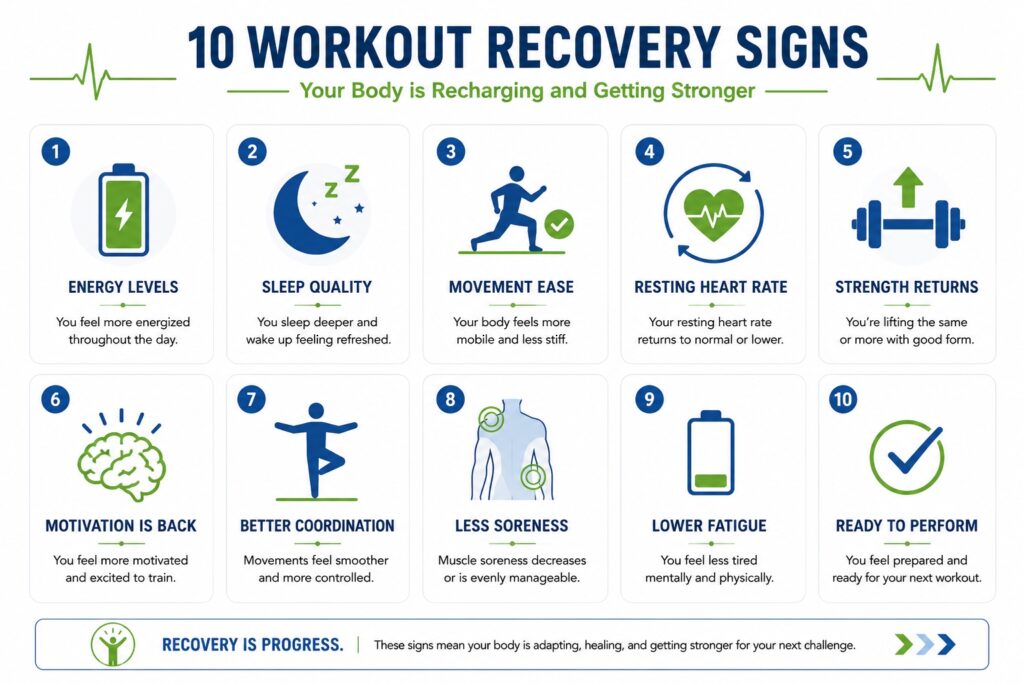
There isn’t a single test that can tell you whether you’re fully recovered. Instead, think of recovery as a puzzle. Each recovery marker provides one piece of information. When several positive signs appear together, you can be more confident that your body is ready for another workout.
The following signs of workout recovery are supported by sports science research and can be assessed without specialized equipment in most cases.

1. Muscle Soreness Has Mostly Improved
Muscle soreness, especially delayed onset muscle soreness (DOMS), is one of the most noticeable effects of a challenging workout. However, soreness is only an indirect sign of recovery. Some people experience significant soreness after a workout yet perform well the next day. Others may have little or no soreness while still experiencing reduced strength or fatigue.
Instead of asking,
“Am I sore?”
Ask,
“Is the soreness mild enough that it doesn’t limit my normal movement or exercise technique?”
If soreness is mild and doesn’t affect how you move, it usually isn’t a reason to avoid training altogether.
Recovery Signal: Mild soreness that doesn’t interfere with normal movement or exercise.
2. Your Energy Levels Feel Normal Again
Energy often reflects recovery better than soreness. After adequate rest, sleep, hydration, and nutrition, everyday activities should feel normal rather than unusually demanding.
If climbing stairs, walking, or performing routine tasks still feels exhausting, your body may not have recovered completely. Low energy can also indicate inadequate sleep, poor nutrition, dehydration, illness, or accumulated training fatigue.
Recovery Signal: You feel physically energized throughout the day instead of unusually tired.
3. Your Performance Has Returned
One of the most reliable recovery indicators is your actual performance. If your usual warm-up feels unusually heavy or your normal training weights suddenly feel much harder than expected, your body may still be recovering. Performance markers include:
- Normal lifting strength.
- Comfortable running pace.
- Usual cycling power.
- Expected movement speed.
- Stable coordination.
A single off day isn’t unusual. However, several consecutive workouts with declining performance deserve attention.
Recovery Signal: Your usual exercises feel like previous sessions.
4. Your Range of Motion Feels Normal
Recovery isn’t just about strength. Healthy movement matters too. Following intense exercise, temporary stiffness can reduce your ability to squat deeply, reach overhead, rotate comfortably, or move through your normal range of motion.
If movement feels restricted despite warming up, additional recovery may be beneficial.
Recovery Signal: Normal flexibility and unrestricted movement during everyday activities and warm-ups.
5. Your Resting Heart Rate Is Close to Your Normal Baseline
Your resting heart rate naturally changes from day to day. However, if it’s consistently higher than your typical baseline, it may suggest that your body is still responding to physical or psychological stress. Many athletes monitor resting heart rate each morning because changes can provide useful context when combined with other recovery signs.
It’s important not to overreact to a single reading. Poor sleep, emotional stress, caffeine, dehydration, illness, and environmental conditions can all influence heart rate.
Recovery Signal: Your resting heart rate is close to your usual baseline rather than remaining noticeably elevated.
6. You Slept Well
Quality sleep is one of the strongest indicators that recovery is progressing well. After a good night’s sleep, many people notice the following:
- Better concentration.
- Improved mood.
- More stable energy.
- Better coordination.
- Greater motivation to exercise.
On the other hand, several nights of poor sleep can affect recovery even if your muscles no longer feel sore. Instead of focusing only on hours slept, also consider whether your sleep felt restful.
Recovery Signal: You wake up feeling rested and alert rather than exhausted.
7. You Feel Mentally Ready to Train
Recovery isn’t purely physical. Mental readiness influences how well you perform and how enjoyable exercise feels.
Ask yourself:
- Am I looking forward to today’s workout?
- Do I feel focused?
- Am I mentally engaged?
A temporary lack of motivation happens to everyone. But persistent reluctance to train, especially when combined with physical fatigue, may indicate that additional recovery is needed.
Recovery Signal: You feel motivated, focused, and prepared to exercise.
8. Your Coordination Feels Normal
The nervous system plays a major role in movement quality. When recovery is incomplete, coordination may decline before strength noticeably changes. You might notice:
- Balance feels less stable.
- Movements seem awkward.
- The technique requires more concentration.
- Exercises feel less controlled.
These subtle changes often appear during warm-ups.
Recovery Signal: Your movements feel smooth, coordinated, and technically consistent.
9. You’re No Longer Feeling Unusually Fatigued
Fatigue and soreness aren’t the same thing. You can have mild soreness while feeling energetic or no soreness while feeling completely drained. Pay attention to how your body feels throughout the day.
Persistent fatigue that doesn’t improve with normal recovery habits deserves more attention than temporary post-workout soreness.
Recovery Signal: Your overall fatigue has returned to your normal baseline.
10. Multiple Recovery Signs Point in the Same Direction
Perhaps the most important recovery marker isn’t a single sign at all. It’s the combination of several positive indicators. Imagine these two situations:
Scenario A
- Mild soreness
- Good sleep
- Normal energy
- Stable heart rate
- Strong performance
Most people would likely tolerate another workout well.
Scenario B
- No soreness
- Poor sleep
- Low energy
- Elevated resting heart rate
- Reduced performance
Despite the absence of soreness, recovery may still be incomplete. Looking at several signs of workout recovery together provides a clearer picture than relying on any one marker.
| Recovery Marker | Why It Matters |
| Energy | Indicates overall recovery status |
| Muscle soreness | Reflects local muscle response |
| Performance | Suggests functional readiness |
| Movement | Identifies mobility limitations |
| Resting heart rate | May reflect recovery from stress |
| Sleep | Supports repair and adaptation |
| Motivation | Indicates mental readiness |
| Coordination | Reflects neuromuscular recovery |
| Fatigue | Signals overall recovery demand |
| Multiple markers | Provides the most reliable assessment |
Recovery Snapshot
Before your next workout, ask yourself:
| Recovery Marker | Ready? |
| Soreness is mild. | ☐ |
| Energy feels normal. | ☐ |
| Performance feels normal. | ☐ |
| Movement feels unrestricted. | ☐ |
| Resting heart rate is near baseline. | ☐ |
| I slept well. | ☐ |
| I’m mentally ready. | ☐ |
| Coordination feels normal. | ☐ |
| Fatigue has improved. | ☐ |
If most of these markers are positive, your body is more likely to be prepared for another productive training session. In the next section, we’ll look at the warning signs that suggest your body may need more recovery time before you increase your training load.
Signs That You May Need More Recovery Time
Not every workout should be followed by another hard training session. Some days, your body sends clear signals that it hasn’t fully recovered. Recognizing these signs early can help you adjust your training before fatigue builds into a larger problem.
One isolated sign doesn’t necessarily mean you should skip your workout. However, when several warning signs appear together, it’s often a good idea to reduce the intensity, choose an active recovery session, or take a rest day.
Persistent Fatigue
It’s normal to feel tired immediately after a challenging workout.
What’s less normal is waking up the next day or even several days later feeling unusually drained despite getting enough sleep and eating normally. Persistent fatigue often affects your workout more. You may notice that everyday activities require more effort than usual or that you struggle to maintain your normal energy throughout the day.
Unlike temporary tiredness, persistent fatigue tends to linger instead of improving with routine recovery.
Recovery Warning Sign: You continue feeling unusually tired for several days after training.
Declining Performance
One of the earliest indicators of incomplete recovery is a noticeable drop in performance.
Ask yourself:
- Are your usual weights feeling much heavier?
- Is your normal running pace becoming harder to maintain?
- Do you get fatigued earlier than expected?
- Has your workout quality declined despite following the same routine?
Everyone experiences occasional off days, especially during stressful periods. However, repeated declines across multiple workouts deserve attention. When performance continues to decrease, pushing harder rarely solves the problem. Recovery often becomes the missing piece.
Recovery Warning Sign: Your performance keeps declining through several training sessions.
Elevated Resting Heart Rate
A temporary increase in resting heart rate can occur after intense exercise. It may also be influenced by:
- Poor sleep
- Emotional stress
- Illness
- Dehydration
- Heat and humidity
- Caffeine intake
Because of these factors, resting heart rate should never be interpreted on its own.
However, if your morning resting heart rate remains consistently higher than your usual baseline for several days and other recovery signs are also poor, it may suggest that your body hasn’t fully recovered.
Recovery Warning Sign: Your resting heart rate stays noticeably above your normal baseline for several consecutive days.
Poor Sleep
Recovery and sleep influence each other. A difficult workout can temporarily affect sleep, and poor sleep can slow recovery from exercise. Occasional restless nights are common.
The concern arises when poor sleep becomes a pattern. Repeated difficulty falling asleep, waking frequently during the night, or feeling unrefreshed in the morning can reduce your body’s ability to recover and adapt to training.
Recovery Warning Sign: Several nights of poor-quality sleep combined with increasing fatigue.
Lingering Joint or Tendon Pain
Muscle soreness is common after unfamiliar or demanding exercise. Joint pain is different. Pain in your knees, shoulders, hips, elbows, ankles, or tendons that persists, worsens during activity, or changes how you move should not be dismissed as “normal recovery.”
Unlike typical muscle soreness, joint and tendon pain may indicate excessive loading, poor movement mechanics, or an overuse injury. Training through persistent joint pain can increase the risk of developing a more significant problem.
Recovery Warning Sign: Pain is localized to a joint or tendon, lasts beyond expected soreness, or changes your movement pattern.
Loss of Motivation
Not every low-motivation day is caused by incomplete recovery. Work stress, poor sleep, emotional strain, and everyday responsibilities can all affect your desire to exercise.
However, when a lack of motivation consistently appears alongside fatigue, poor performance, and disturbed sleep, it may reflect accumulated training stress rather than simple laziness. Instead of forcing another hard workout, it may be more productive to prioritize recovery and return with higher-quality training.
Recovery Warning Sign: You consistently dread workouts that you would normally enjoy.
| Normal Recovery | Warning Signs |
| Mild soreness | Severe or worsening pain |
| Temporary fatigue | Persistent exhaustion |
| Normal performance returns | Performance continues to decline. |
| Good sleep | Ongoing poor sleep |
| Stable resting heart rate | Elevated resting heart rate |
| Comfortable movement | Joint pain or restricted movement |
When Several Warning Signs Appear Together
One warning sign rarely tells the whole story.
For example:
- A single poor night’s sleep doesn’t automatically mean you should cancel your workout.
- Mild soreness after leg day isn’t unusual.
- One slower workout doesn’t necessarily indicate inadequate recovery.
The picture changes when several warning signs occur at the same time. If you notice:
- Persistent fatigue,
- Declining performance,
- Poor sleep,
- Elevated resting heart rate,
- Reduced motivation,
Your body is providing stronger evidence that it may need additional recovery before another demanding session. Looking at these markers together helps you make more informed training decisions instead of reacting to a single symptom.
Recovery Decision
If you recognize multiple warning signs, consider one of these options instead of proceeding with a high-intensity workout:
- Reduce the intensity of your planned session.
- Train a different muscle group if appropriate.
- Choose active recovery, such as walking, cycling, or mobility work.
- Take a full rest day if fatigue is widespread or persistent.
The goal isn’t to avoid training; it’s to train when your body is most prepared to benefit from it. In the next section, we’ll explore one of the biggest misconceptions in fitness: whether muscle soreness really tells you if you’ve recovered or if it’s safe to work out again.
Muscle Soreness vs. Full Recovery
For many people, muscle soreness is the first thing they notice after a workout. It’s also one of the most misunderstood signs of recovery. A common belief is
If I’m still sore, I shouldn’t exercise. If I’m not sore, I’m fully recovered.
Neither statement is always true. Muscle soreness can provide useful information, but it doesn’t tell the whole story. To make better training decisions, it’s important to understand what soreness represents and what it doesn’t.
Why DOMS Can Be Misleading
The muscle soreness that develops 12 to 48 hours after exercise is known as delayed onset muscle soreness (DOMS).
DOMS is most common after:
- Starting a new exercise program.
- Increasing training intensity.
- Performing more repetitions or volume than usual.
- Exercises with a strong eccentric (muscle-lengthening) component, such as downhill running or lowering weights.
Although DOMS often occurs alongside the recovery process, it isn’t a direct measure of how well your body has recovered.
For example:
- You can have noticeable soreness while your muscles can perform well.
- You can have little or no soreness even though your nervous system, energy stores, or connective tissues haven’t fully recovered.
In other words, soreness reflects one response to exercise, not your overall readiness to train.
Why Some People Feel Very Sore and Others Don’t
Not everyone experiences DOMS in the same way. The intensity of soreness can vary depending on the following:
- Your training experience.
- The type of exercise performed.
- Workout intensity and volume.
- Genetics.
- Sleep quality.
- Nutrition.
- Previous exposure to exercise.
Someone beginning a strength-training program may experience significant soreness after a single workout, while an experienced lifter performing the same session may have very little soreness because their body has already adapted.
This difference doesn’t necessarily mean one person recovered better than the other. It simply shows that soreness is influenced by many factors beyond recovery itself.
Can You Work Out While Still Sore?
In many cases, yes, provided the soreness is mild and doesn’t affect how you move or perform the planned workout. For example, you can often continue training if:
- The soreness is mild.
- Your movement remains comfortable.
- Your technique isn’t affected.
- Your energy levels are normal.
- Your performance hasn’t noticeably declined.
However, it may be better to postpone or modify your workout if:
- Soreness is severe.
- Your range of motion is significantly reduced.
- You can’t maintain proper exercise technique.
- Everyday activities remain painful.
- Soreness is accompanied by unusual fatigue or poor performance.
The decision shouldn’t be based on soreness alone. Instead, consider it alongside the other signs of workout recovery discussed earlier.
Muscle Soreness vs. Injury Pain
Another important distinction is the difference between normal muscle soreness and pain that may indicate an injury. Typical DOMS usually
- Affects both sides of the body similarly.
- Feels dull, stiff, or achy.
- Improves gradually over several days.
- Decreases as your muscles warm up.
Pain that deserves medical attention often:
- Is sharp, stabbing, or burning.
- Occurs in a specific joint or tendon.
- Causes swelling or instability.
- Worsens during movement.
- Doesn’t improve with time or rest.
If you’re unsure whether you’re experiencing normal soreness or an injury, it’s safer to reduce training intensity and seek evaluation from a qualified healthcare professional.
A Better Question to Ask
Instead of asking:
“Am I still sore?”
Ask yourself:
“Is soreness preventing me from moving well or performing today’s workout safely?”
This small shift changes the focus from a single symptom to overall function. Combined with your energy, sleep, performance, movement quality, and other recovery markers, it leads to a more informed training decision.
Key Takeaway
Muscle soreness is one recovery marker, not the recovery marker. Some soreness can be perfectly compatible with productive training, while the absence of soreness doesn’t guarantee that your body is fully prepared for another demanding workout.
The most reliable approach is to evaluate multiple signs of workout recovery together rather than allowing soreness alone to determine whether you should train.
In the next section, we’ll examine typical recovery timelines after different types of exercise and why recovery varies from one person and one workout to another.
Muscle Soreness vs. Full Recovery
One of the most common mistakes people make is assuming that muscle soreness and recovery mean the same thing. While they’re related, they describe different aspects of how your body responds to exercise.
Delayed onset muscle soreness (DOMS) is the discomfort or stiffness that typically develops 12–24 hours after unfamiliar or intense exercise and may peak between 24 and 72 hours. It’s a normal response to training, but it doesn’t tell the whole story about your recovery.
For example, your muscles may no longer feel sore, yet your nervous system or energy stores may still be recovering. On the other hand, you might experience mild soreness while your overall performance, movement quality, and energy levels have already returned to normal.
That’s why soreness should be viewed as one recovery marker—not the recovery marker.
Muscle Soreness vs. Full Recovery
| Muscle Soreness | Full Recovery |
| Refers to discomfort in the muscles after exercise. | Refers to your body’s overall readiness to train again. |
| Usually caused by unfamiliar or demanding exercise. | Depends on multiple systems recovering together. |
| Can improve within a few days. | Recovery time varies based on workout type and individual factors. |
| Doesn’t measure energy, sleep, or nervous system recovery. | Includes physical performance, movement quality, sleep, and mental readiness. |
| May still be present even when training is appropriate. | Assessed by considering several recovery markers together. |
Can You Train While You’re Still Sore?
In many cases, yes.
If your soreness is mild, your movement is unrestricted, your technique remains good, and your energy feels normal, you can often continue training safely. Many training programs are designed with this in mind by alternating muscle groups or adjusting workout intensity.
However, if soreness is severe enough to change your movement, reduce your performance, or make everyday activities difficult, your body may benefit from additional recovery before another demanding session.
The goal isn’t to eliminate every trace of soreness—it’s to determine whether your body is recovered enough for the workout you plan to do today.
Key Takeaway
Muscle soreness provides useful information, but it doesn’t define recovery on its own. The most reliable approach is to evaluate soreness alongside your energy, performance, movement quality, sleep, resting heart rate, and mental readiness before deciding to train again.
Recovery Timelines After Different Types of Exercise
One of the most common questions after a workout is
“How long should I wait before training again?”
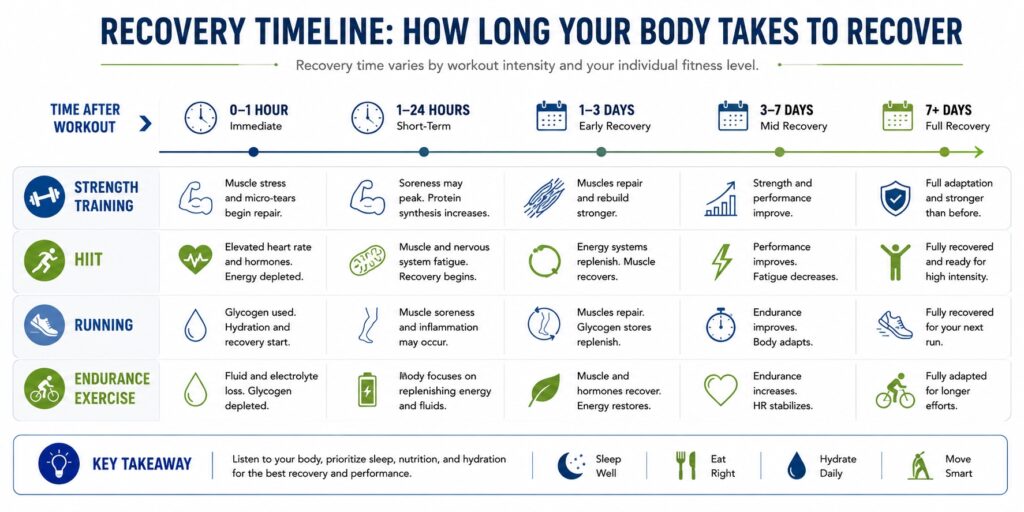
There’s no single answer. Recovery depends on what you did, how hard you trained, and how your body responds. Two people can complete the same workout and recover at different rates because of differences in age, training experience, sleep, nutrition, stress, and overall health.
Instead of following a fixed number of hours, use recovery timelines as a general guide and combine them with the signs of workout recovery you’ve already learned.
Strength Training
Moderate to heavy strength training creates mechanical stress in muscles and connective tissues. Larger muscle groups and high-volume sessions usually require more recovery than shorter or lighter workouts.
Most people recover from a typical strength-training session within 24 to 72 hours, although this varies depending on the following:
- Training intensity.
- Number of sets and repetitions.
- Exercises performed.
- Training experience.
- Recovery habits.
This is why many strength-training programs rotate muscle groups instead of training the same muscles on consecutive days.
High-Intensity Interval Training (HIIT)
HIIT places significant demands on both the muscles and the cardiovascular system. Because of its intensity, recovery often depends on the duration and difficulty of the session. Many people are ready for another high-intensity workout within 24 to 72 hours, while light activity such as walking or mobility exercises can often be performed sooner.
If fatigue remains high, replacing another HIIT session with lower-intensity exercise may be more productive.
Running
Recovery after running depends largely on distance and intensity.
For example:
- An easy recovery run may require less than a day of recovery.
- A tempo run or interval session may require one to two days.
- A long-distance race or very demanding run can require several days or longer.
Rather than focusing only on mileage, pay attention to how your legs feel, whether your running form remains efficient, and whether your energy has returned.
Endurance Events
Events such as marathons, ultramarathons, long-distance cycling events, and triathlons place substantial stress on multiple body systems. Although soreness may improve within a few days, complete recovery can take several days or even weeks, depending on:
- Event duration.
- Training status.
- Environmental conditions.
- Nutrition and hydration.
- Sleep quality.
Returning to high-intensity training too quickly after an endurance event may delay recovery rather than accelerate it.
Beginners vs. Experienced Exercisers
Training experience has a significant influence on recovery.
Beginners
People who are new to exercising often experience the following:
- More muscle soreness.
- Longer recovery times.
- Greater fatigue after unfamiliar workouts.
- Slower adaptation during the first few weeks.
This is a normal response as the body adjusts to new physical demands.
Experienced Exercisers
Regular training improves the body’s ability to recover. Experienced exercisers often:
- Recover more efficiently.
- Experience less soreness from familiar workouts.
- Tolerate higher training volumes.
- Recognize their own recovery patterns more accurately.
However, experience doesn’t eliminate the need for recovery. Even well-trained athletes require adequate rest after demanding sessions.
Factors That Influence Recovery Time
Recovery isn’t determined by exercise alone. Several factors influence how quickly your body is ready for the next workout, including:
- Workout intensity.
- Training volume.
- Exercise type.
- Age.
- Sleep quality.
- Daily nutrition.
- Hydration.
- Psychological stress.
- Previous injuries.
- Overall health.
- Environmental conditions such as heat and humidity.
Because these factors vary from person to person, recovery timelines should be viewed as estimates rather than strict rules.
Typical Recovery Timeline
| Exercise Type | Typical Recovery Time* |
| Light walking or gentle cycling | Within 24 hours |
| Moderate cardio | 24 hours |
| Moderate strength training | 24–48 hours |
| Heavy strength training | 48–72 hours |
| HIIT | 24–72 hours |
| Long-distance running | 2–5 days |
| Marathon or similar endurance event | Several days to 2 weeks |
These are general estimates. Individual recovery varies based on training status, exercise intensity, sleep, nutrition, stress, age, and overall health.
Recovery Is Individual
Recovery isn’t measured by the calendar. Two people may both wait 48 hours after a workout, yet one feels refreshed while the other continues to experience fatigue and reduced performance. That’s why time alone isn’t the best indicator of recovery.
A more reliable approach is to use recovery time as a starting point and confirm it with your body’s signals, including energy, performance, sleep, movement quality, and the other signs of workout recovery discussed earlier.
In the next section, we’ll combine these recovery markers into a simple workout recovery checklist that helps you decide whether to train, reduce your workout intensity, or take another recovery day.
A Simple Workout Recovery Checklist
By now, you’ve seen that no single sign can determine whether you’re ready for another workout. Instead of asking one question, such as “Am I still sore?”, it’s more helpful to look at several recovery markers together. The checklist below isn’t designed to give a perfect answer. It’s designed to help you make a better-informed training decision based on the information your body is providing today.
Step 1: Check Your Physical Recovery
Ask yourself the following questions:
| Recovery Marker | Yes | No |
| Muscle soreness is mild or improving. | ☐ | ☐ |
| My energy levels feel normal. | ☐ | ☐ |
| My movements feel comfortable and unrestricted. | ☐ | ☐ |
| My performance during warm-up feels normal. | ☐ | ☐ |
| My resting heart rate is close to my usual baseline (if I monitor it). | ☐ | ☐ |
If most of your answers are “Yes,” your physical recovery is moving in the right direction.
Step 2: Check Your Mental Recovery
Physical recovery is only part of the picture.
Ask yourself:
| Recovery Marker | Yes | No |
| I slept well last night. | ☐ | ☐ |
| I feel mentally focused. | ☐ | ☐ |
| I’m motivated to train today. | ☐ | ☐ |
| I don’t feel unusually fatigued. | ☐ | ☐ |
These questions help identify recovery factors that aren’t always visible through muscle soreness alone.
Step 3: Look for Warning Signs
Now ask yourself whether any of these apply today:
- Persistent fatigue.
- Poor sleep for several nights.
- Declining workout performance.
- Severe muscle soreness.
- Joint or tendon pain.
- Elevated resting heart rate.
- Feeling unwell or becoming ill.
One warning sign doesn’t automatically mean you should cancel your workout. However, several warning signs appearing together deserve attention.
How to Use Your Answers
🟢 Green Light—Train as Planned
You can usually continue with your planned workout when:
- Most recovery markers are positive.
- Energy feels normal.
- Movement is comfortable.
- Performance feels close to normal.
- Fatigue is low.
Your body appears well prepared for today’s training session.
🟡 Yellow Light — Modify Your Workout
Consider reducing today’s training load if:
- You’re recovering reasonably well but not at your best.
- Mild soreness remains.
- Sleep wasn’t ideal.
- Energy feels slightly lower than usual.
Possible adjustments include:
- Reduce training volume.
- Lower workout intensity.
- Extend your warm-up.
- Replace high-intensity intervals with steady exercise.
- Focus on technique instead of maximum effort.
Training doesn’t always need to be skipped; sometimes it simply needs to be adjusted.
🔴 Red Light — Prioritize Recovery
A recovery-focused day may be the better choice if several warning signs occur together, such as
- Persistent fatigue.
- Poor performance.
- Severe soreness.
- Joint pain.
- Poor sleep.
- Elevated resting heart rate.
- Feeling physically or mentally exhausted.
In these situations, continuing with a demanding workout may reduce training quality and delay recovery. Instead, consider:
- Walking.
- Gentle cycling.
- Mobility exercises.
- Stretching.
- A complete rest day if needed.
Remember, recovery is part of the training process, not time away from it.
Don’t Chase Perfect Recovery
Many people wait until they feel 100% before exercising again. Others ignore every sign of fatigue and push through every workout. Neither approach is ideal. The goal isn’t to feel perfect.
The goal is to be recovered enough for the workout you’re planning today. That decision becomes much easier when you consider multiple signs of workout recovery instead of relying on a single symptom.
Recovery Decision Framework
Before every workout, ask yourself these three questions:
- Do I feel physically recovered?
- Do I feel mentally ready to train?
- Are there any warning signs suggesting I should reduce today’s training load?
If your answers consistently point in the same direction, you’ll usually make a better training decision than by relying on soreness or any other single recovery marker alone.
In the next section, we’ll separate common myths from scientific evidence, including whether “no soreness means full recovery,” “more rest always produces better results,” and whether wearable recovery scores can accurately tell you when you’re ready to train.
Common Myths About Workout Recovery
Recovery advice is everywhere. Some recommendations are based on scientific evidence, while others have been repeated so often that they sound true despite lacking strong support. Understanding the difference can help you make better training decisions and avoid common misconceptions.
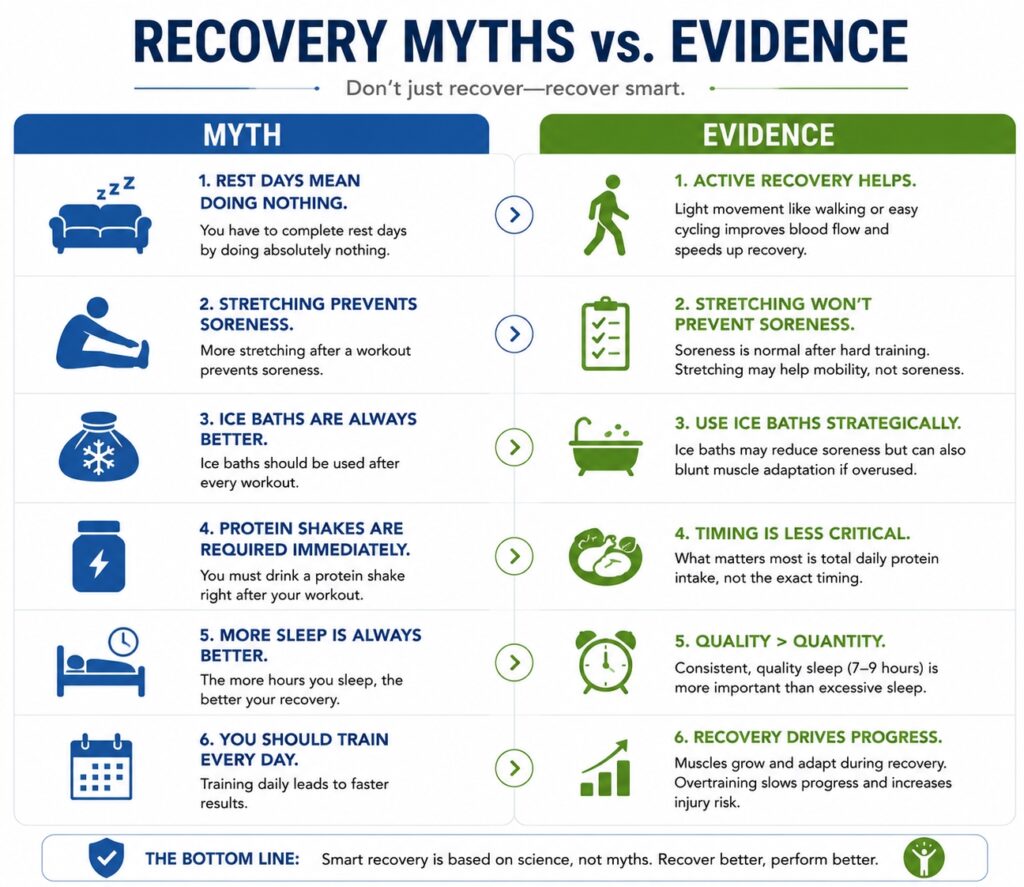
Myth 1: No Soreness Means You’re Fully Recovered
The Myth
“If my muscles aren’t sore anymore, I’m ready for another hard workout.”
What Evidence Shows
Muscle soreness is only one response to exercise. While soreness often improves as recovery progresses, it doesn’t measure every aspect of recovery. Your muscles may feel normal even though your nervous system, energy stores, or connective tissues are still adapting.
Likewise, mild soreness doesn’t automatically mean you should avoid training. This is why soreness should be considered alongside other recovery markers, such as
- Energy levels.
- Performance.
- Sleep quality.
- Movement quality.
- Resting heart rate.
- Mental readiness.
Practical Takeaway
Don’t let soreness alone decide whether you train. Look at your overall recovery picture.
Myth 2: More Rest Always Leads to Better Results
The Myth
“The longer I rest, the better my body will recover.”
What Evidence Shows
Recovery is essential, but more isn’t always better. Taking enough time to recover allows your body to adapt to training. However, consistently delaying workouts after you’ve already recovered may reduce training frequency and slow long-term progress.
On the other hand, returning too early can leave you training with unnecessary fatigue. The goal is to find the balance between recovery and consistent training—not to maximize either one in isolation.
Practical Takeaway
Recover enough to train well, not simply to rest longer.
Myth 3: Wearable Recovery Scores Always Know Best
The Myth
“My smartwatch says I’m only 62% recovered, so I shouldn’t exercise.”
What Evidence Shows
Many wearable devices estimate recovery using data such as the following:
- Heart rate variability (HRV).
- Resting heart rate.
- Sleep.
- Previous activity.
These measurements can provide useful information, but they don’t directly measure muscle repair or predict how you’ll perform on a particular day.
Recovery scores are estimates, not medical assessments. They work best when combined with your own observations, including how you feel, move, and perform.
Practical Takeaway
Use wearable data as one piece of information, not the final decision-maker.
Myth 4: You Must Wait Until You’re 100% Recovered
The Myth
“I shouldn’t exercise until I feel completely recovered.”
What Evidence Shows
Very few people feel perfect before every workout. Minor soreness, slight tiredness, or feeling less than your absolute best doesn’t necessarily prevent productive training.
Many structured training programs intentionally alternate demanding sessions with lighter ones, allowing recovery to continue while maintaining consistency. The important question isn’t whether you feel perfect. It’s whether you’re recovered enough for the workout you’ve planned.
Practical Takeaway
Aim for appropriate recovery, not perfect recovery.
Myth 5: Recovery Is the Same for Everyone
The Myth
“Everyone needs 48 hours to recover after a workout.”
What Evidence Shows
Recovery varies widely between individuals. Factors such as
- Age.
- Training experience.
- Exercise intensity.
- Nutrition.
- Sleep.
- Stress.
- Overall health.
All influences how quickly your body adapts after exercise. That’s why fixed recovery timelines should be viewed as general guidelines rather than universal rules.
Practical Takeaway
Compare your recovery to your own normal patterns, not someone else’s.
Myth 6: More Pain Means a Better Workout
The Myth
“The sorer I am, the more effective my workout was.”
What Evidence Shows
Soreness often reflects that your body performed unfamiliar or demanding work, but it doesn’t measure workout quality. A highly effective training session may produce very little soreness, especially if your body has adapted to that type of exercise.
Likewise, extreme soreness can interfere with movement quality, delay recovery, and reduce the quality of your next workout. Progress comes from consistent adaptation—not from chasing soreness.
Practical Takeaway
Judge your workouts by consistent improvement in performance, not by how sore you feel afterward.
Myth vs. Evidence Summary
| Myth | Evidence-Based Reality |
| No soreness means full recovery. | Recovery involves multiple body systems, not just muscle soreness. |
| More rest is always better. | Recovery should support consistent, high-quality training. |
| Wearable recovery scores are always accurate. | They provide useful estimates but shouldn’t replace your own recovery assessment. |
| You must feel 100% before training. | Many workouts can be productive without perfect recovery. |
| Everyone recovers in the same amount of time. | Recovery varies from person to person and from workout to workout. |
| A sore workout is always a successful workout. | Progress depends on adaptation and consistency, not soreness alone. |
The Bottom Line
Most recovery myths develop because they rely on a single idea—one symptom, one number, or one rule. Scientific evidence points to a different conclusion. Recovery is a combination of biological repair, restored performance, adequate energy, quality sleep, healthy movement, and mental readiness.
The most reliable way to decide whether you’re ready for your next workout is to evaluate several signs of workout recovery together instead of relying on any one indicator.
When to Delay Your Next Workout
Recovery doesn’t always mean taking a complete day off. In many cases, adjusting your workout is enough. However, there are situations where delaying a high-intensity session is the safer and more productive decision. The goal isn’t to avoid training. It’s to avoid training before your body is prepared to benefit from it.
You’re Experiencing Several Recovery Warning Signs
One warning sign may not mean much. Several occurring together deserve attention. Consider postponing or modifying your workout if you notice:
- Persistent fatigue.
- Poor-quality sleep for several nights.
- Declining performance.
- Elevated resting heart rate.
- Severe muscle soreness.
- Low motivation combined with physical fatigue.
These signs suggest your body may still be recovering from previous training or other life stressors.
| Recovery Status | Recommendation |
| Most recovery markers are positive. | Train as planned. |
| Mild soreness with good energy | Train with minor adjustments if needed |
| Several warning signs | Reduce intensity or choose active recovery. |
| Joint pain, illness, or severe fatigue | Delay strenuous exercise and recovery. |
Your Technique Changes During the Warm-Up
Your warm-up can reveal a lot about your recovery. Pay attention to questions such as the following:
- Do your movements feel unusually heavy?
- Is your balance worse than usual?
- Does your technique break down during familiar exercises?
- Are weights that normally feel comfortable suddenly difficult?
If your movement quality doesn’t improve after warming up, your body may not be ready for a demanding session. In some cases, reducing the intensity or switching to a recovery-focused workout is a better choice.
You Have Joint or Tendon Pain
Normal muscle soreness is expected after challenging exercise. Pain is different. If you experience:
- Sharp pain.
- Pain inside a joint.
- Pain that worsens during movement.
- Swelling.
- Instability.
- Pain changes how you move.
Stop and reassess your workout. Unlike typical muscle soreness, these symptoms may indicate an injury or excessive tissue stress. Continuing to train through joint pain may increase the risk of further damage.
You’re recovering from an illness.
Returning to exercise too soon after an illness may delay recovery and reduce training performance.
If you have:
- Fever.
- Chest symptoms.
- Significant fatigue.
- Muscle weakness.
- Dizziness.
It’s generally best to postpone strenuous exercise until you’ve recovered. If symptoms persist or you’re unsure when to return to training, consult a qualified healthcare professional.
You’re sleep-deprived.
One poor night’s sleep doesn’t automatically require a rest day. However, several consecutive nights of inadequate or poor-quality sleep can affect:
- Coordination.
- Decision-making.
- Reaction time.
- Strength.
- Endurance.
- Recovery.
If you’re significantly sleep-deprived, consider replacing a high-intensity workout with a lighter session until your sleep improves.
Your body feels different than usual.
Experience often teaches you what “normal” feels like. Sometimes there isn’t one obvious warning sign. Instead, you simply notice that:
- Everything feels unusually difficult.
- Your body feels unusually heavy.
- You’re struggling to focus.
- Your movements don’t feel natural.
These observations shouldn’t be ignored. Although they’re subjective, they often provide useful context when combined with other recovery markers.
Delay Doesn’t Mean You’re Losing Progress
Many people worry that skipping or postponing a workout will undo weeks of training. One recovery-focused day has very little effect on long-term fitness. What has a much greater impact is repeatedly training with excessive fatigue, poor movement quality, or unresolved pain.
Fitness develops over weeks and months, not from a single workout. Making occasional adjustments based on your recovery can support more consistent training over time.
What Should You Do Instead?
If you’re not ready for your planned workout, you don’t necessarily have to remain inactive. Depending on how you feel, you might choose to
- Go for a walk.
- Perform gentle cycling.
- Complete a mobility session.
- Stretch lightly.
- Practice technique with lighter loads.
- Perform breathing or relaxation exercises.
- Take a complete rest day if recovery is clearly needed.
The appropriate choice depends on the type and severity of your recovery limitations.
Decision Guide
Use this simple guide before every workout.
| Your Recovery Status | Suggested Action |
| Most recovery markers are positive. | Proceed with your planned workout. |
| Mild fatigue or soreness but otherwise feeling well. | Reduce intensity or training volume if needed. |
| Multiple recovery warning signs are present. | Prioritize active recovery or rest. |
| Joint pain, illness, dizziness, or movement-limiting pain. | Delay strenuous exercise and seek medical advice if symptoms persist. |
Key Takeaway
Delaying a workout isn’t a setback. It’s a decision that allows your body to complete the recovery process before facing another significant training demand. The objective isn’t to train every day at maximum intensity. The objective is to train consistently, recover effectively, and make decisions that support your long-term health and performance.
When to Consult a Healthcare Professional
Most muscle soreness and post-workout fatigue improve with time, rest, and appropriate recovery. However, some symptoms may indicate an injury or an underlying medical condition rather than normal exercise recovery.
Consider seeking advice from a qualified healthcare professional if you experience:
- Severe or worsening pain that doesn’t improve with rest.
- Swelling, redness, or significant bruising around a joint or muscle.
- Pain that prevents normal movement or weight-bearing.
- Persistent fatigue that lasts for several days or continues to worsen.
- Dizziness, fainting, chest pain, or shortness of breath during or after exercise.
- Fever, signs of infection, or feeling unwell following a workout.
- Symptoms that continue despite reducing your training load and allowing adequate recovery.
Early assessment can help identify injuries or medical conditions that may require specific treatment and reduce the risk of further complications.
Medical Disclaimer
This article is intended for educational and informational purposes only and should not be considered medical advice, diagnosis, or treatment. Individual recovery needs vary based on factors such as age, health status, fitness level, training history, and medical conditions.
Always consult a qualified healthcare professional before starting a new exercise program or if you have persistent pain, recurring injuries, or concerns about your recovery. If you experience severe symptoms such as chest pain, difficulty breathing, loss of consciousness, or other signs of a medical emergency, seek immediate medical care.
Conclusion
Understanding the signs of workout recovery isn’t about waiting for one perfect signal; it’s about recognizing the bigger picture.
Your energy, performance, movement quality, sleep, resting heart rate, motivation, and muscle soreness all provide valuable information about how well your body has recovered. Looking at these markers together helps you make more informed training decisions than relying on soreness or the number of hours since your last workout.
Remember that recovery isn’t the opposite of progress; it’s part of the adaptation process that allows your body to become stronger, fitter, and more resilient. Some days you’ll be ready to train at full intensity, while on others, modifying your workout or taking an extra recovery day may be the better choice.
Instead of asking, “Am I completely recovered?” ask yourself:
“Am I recovered enough to perform today’s workout safely and effectively?”
Using that mindset can help you train more consistently, reduce unnecessary fatigue, and support long-term performance without ignoring the signals your body provides.
Frequently Asked Questions
What are the signs of workout recovery?
The main signs of workout recovery include normal energy, mild or improving soreness, good sleep, normal movement, stable performance, and feeling mentally ready to exercise.
Can I work out if I’m still sore?
Yes, if the soreness is mild and doesn’t affect your movement or exercise technique. Severe soreness or pain may mean you need more recovery.
How long does workout recovery usually take?
Recovery can take anywhere from 24 hours to several days, depending on the type and intensity of exercise and your individual recovery.
Does resting heart rate indicate recovery?
It can help. A resting heart rate close to your normal baseline may suggest good recovery, but it should be considered alongside other recovery signs.
Is heart rate variability (HRV) necessary to know if I’m recovered?
No. HRV can provide useful information, but you can assess recovery effectively using your energy, sleep, performance, and other recovery markers.
Can I train every day if I feel fine?
Yes, provided your training is well planned and allows different muscles and body systems enough time to recover.
Should beginners take more recovery days?
Often, yes. Beginners usually need more recovery because their bodies are still adapting to new training demands.
What’s the difference between fatigue and muscle soreness?
Muscle soreness is localized discomfort after exercise, while fatigue is a broader feeling of reduced physical or mental energy. They can occur together or separately.
References
Official Organizations
- American College of Sports Medicine (ACSM) — https://www.acsm.org/
- National Strength and Conditioning Association (NSCA) — https://www.nsca.com/
- International Olympic Committee (IOC) Consensus Statements — https://olympics.com/ioc
- American Medical Society for Sports Medicine (AMSSM) — https://www.amssm.org/
High-Impact Journals
- Sports Medicine
- British Journal of Sports Medicine
- Journal of Strength and Conditioning Research
- Medicine & Science in Sports & Exercise
- Journal of Applied Physiology
- International Journal of Sports Physiology and Performance
- European Journal of Sport Science
- Sleep Medicine Reviews
- Frontiers in Physiology

I’m Mr. Baig, founder of Recover Better Lab. I create evidence-based fitness recovery content to help beginners recover smarter and build sustainable healthy habits.
Mission: My mission is to provide trustworthy, research-backed recovery and fitness content that helps people optimize their health, performance, and overall well-being.